Showing posts with label Saint's Days. Show all posts

St. Walburga's Day

From the blog Logismoi. Full article there discusses Walpurgisnacht and Dracula mythos.


Happy May Day!  I've found something new this year...I've often heard the term Walpurgisnacht used to describe the night before May Day...it's traditionally a time in Northern and Central Europe (most often it would seem in Germany, Norway, Estonia and Latvia) when big bonfires are held, and parties thrown.  Most of these traditions date back to the Europe's witch hunt era, and the feel is often similar to Halloween--a date six months later.  In Bavaria it's know as Freinacht, and pranks are played as well. 


Saint Walburga traveled from England to Germany to proselyte sometime around the year 748 A.D, and became a very powerful and influential Abbess.  She was known for healing, and even after her death was said to have a healing "oil" rise from her grave(the reason for the flask she is often shown carrying). 
Oldest known image of Walpurga, from the Hitda Codex.

In addition to the flask, she is sometimes shown with a book to represent her writings, as well as heads of grain.  The story often goes that she fed a starving child using only three heads of grain, however this tale seems to be a later addition.  There is some fascinating evidence that the Saint became a stand-in for an older Germanic grain goddess, taking on the role of "protectress of crops". 

This is the point where it gets complicated, though, since the older goddess is often only referred to as Walpurga.  She is often linked to the Wild Hunt in this form;

"Nine nights before the first of May is Walburga in flight, unceasingly chased by wild ghosts and seeking a hiding place from village to village. People leave their windows open so she can be safe behind the cross-shaped windowpane struts from her roaring enemies. For this, she lays a little gold piece on the windowsill, and flees further. A farmer who saw her on her flight through the woods described her as a white lady with long flowing hair, a crown upon her head; her shoes were fiery gold, and in her hands she carried a three-cornered mirror that showed all the future, and a spindle, as does Berchta. A troop of white riders exerted themselves to capture her. So also another farmer saw her, whom she begged to hide her in a shock of grain. No sooner was she hidden than the riders rushed by overhead. The next morning the farmer found grains of gold instead of rye in his grain stook. Therefore, the saint is portrayed with a bundle of grain." (Rochholz,Drei Gaugtinen (Three Local Goddesses), 1870, p. 26-27)

For more such quotes, linked to a pagan perspective, this article on Frigga's Web is excellent.     Many Asatru and similar groups now honor Walpurga because of this mixed history.  For more about May Day celebrations, and traditions such as maypoles, the may queen, and the U.K. tradition of Morris Dancers, go here.   

December 13th, St. Lucy's Day

 Night walks with a heavy step
Round yard and hearth,
As the sun departs from earth,
Shadows are brooding.
There in our dark house,
Walking with lit candles,
Santa Lucia, Santa Lucia!

Night walks grand, yet silent,
Now hear its gentle wings,
In every room so hushed,
Whispering like wings.
Look, at our threshold stands,
White-clad with light in her hair,
Santa Lucia, Santa Lucia!

Darkness shall take flight soon,
From earth's valleys.
So she speaks
Wonderful words to us:
A new day will rise again
From the rosy sky…
Santa Lucia, Santa Lucia!
--Santa Lucia, Traditional Swedish Folk Song

St. Lucy's Liturgy
This post is obviously a little late, but I wanted to touch on it before the month was up.  Saint Lucy is a very interesting figure.  Her story is that she was a young woman in ancient Sicily during the reign of Diocletian.  A devout Christian, she converted her mother by curing her illness by praying at the tomb of Saint Agatha.  Her intended fiance, however, was unmoved, and betrayed her as a Christian.  Legends differ about the bowl she usually carries containing a pair of eyes.  In some versions, her eyes are removed as part of her torture by the local governor, in others, she plucks them out and gives them to her admirer,  begging him to leave her alone to worship God. 


by
Lucy comes from the same root word as light, and between her name and story, she is the patron of eyesight, including the blind.  While she is celebrated in many countries, receiving special devotion in Italy and Catholic parts of Switzerland.

It is in Scandinavia, particularly Sweden, however, that devotion to Saint Lucy took an interesting twist.  There, she has attributes that she doesn't have elsewhere, and still has a strong tradition despite centuries of Lutheran majority, and a strong secular modern culture. 


The oldest daughter in a house will get up before light, put on a white dress with a red sash, and wear a wreath with candles in her hair.  She then will serve hot drinks and breakfast to her family.  Processions, involving Lucy and her followers, children dressed in white, with silver crowns for the girls and tall pointed hats with stars for the boys, will go to schools, elder care centers, and other public places as well. 


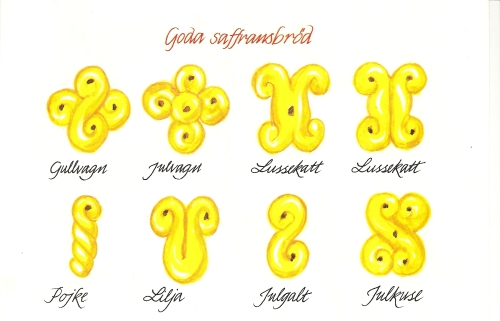
White, red, green wreaths and candles...none of which belong to St. Lucy in her native Italy.  It's enough to make one think, "well, huh".  Especially since the 12th or  13th was the Solstice for many years in the old Julian Calendar.  What is the Scandinavian St. Lucy a memory of, exactly?  What did the Catholic tradition mesh with, and allow to continue?  Why are her little saffron buns often referred to as Kattr--cats?  At this point, St. Lucy makes me ask more questions then she answers, but the traditions linked to her--her light shining in the darkness--make this something worth further investigation. 
Recipe here.

Soda Bread and Colcannon...St. Patrick's Day!


I'm sure most Americans are somewhat familiar with St. Patrick, so I'm not going to get into his story, like I did with St.David of Wales, as the average American schoolchild has surely been told the story about St. Patrick driving the snakes from Ireland, whether they see it as a veiled reference to earlier pagan practices or not.   

Leeks and Daffodils--Happy Early Saint David's Day!


"Be joyful, and keep your faith and your creed. Do the little things that you have seen me do and heard about. I will walk the path that our fathers have trod before us."--Saint David

If you're American, chances are that March equals St. Patrick's Day.  Did you know, though, that each of the portions of the United Kingdom have a patron saint, and a local celebration of their unique culture and roots?

Dia de Los Muertos


First of all, check out The Old Foodie--here is a great post on Soulmass Bread today.


Michaelmas


Now the Harvest is in,
Grain is in the bin.
Through hard work and God's aid
The year's rent has been paid.
With Pennies to spare
We're off to the Michaelmas Fair!