Showing posts with label the Victorians. Show all posts

Great Grandmother's Easter

More beautiful vintage cards can be seen at the Greencastle Museum website. 


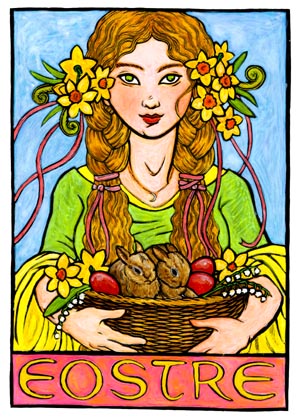
Art by Thalia Took
Easter time is a unique blend of  Catholic and Pre-Christian traditions all over Europe.  The name of the holiday itself comes from a Germanic goddess, and variations on the name range from Eostre to Ostara. Linguists theorize a Proto-Indo-European word awes, meaning "to shine", which would explain similarities to Greek and Roman dawn goddesses(Eos and Aurora) as well as the minor Indian goddess Ushas.  Whatever the case, at least in Northern Europe, common themes are flowers, hares (the predecessor of the Easter Bunny), and eggs. This linguistic link does not carry over into cultures that speak Latin-based languages, however, where Easter is called La Pasquette, Paques, or Pascua. 

The date of Easter changes each year(unlike stationary holidays, like Christmas) because it falls on the Sunday after the first full moon following the Spring Equinox.  Why this reliance on the lunar calendar?  Because the Council of Nicaea reasoned that Passover, which falls on that new moon, would have come directly before the death of Christ. 

 So what did our great grandmothers do for Easter?  It depends...while many traditions translate easily to similar American customs, others are very unique. 

There are eggs a-plenty:

 
Spectacular Swiss Eggs from You Craft Me Up
Romanian Eggs
From Poland

As well as bread and cakes:
Greek Easter Bread, recipe here. 
Swiss Easter Cake
Hot Cross Buns, a favorite at our house.


In Sweden, little children also dress up as Easter Witches, complete with painted red cheeks and freckles, and go door-to-door for treats, based on a tradition that all the local witches fly over the water to a mountain in Northern Germany the Thursday before Easter for a meeting with the devil (another one of those "huh" moments...some suggest the tradition dates to a rather ugly witch hunt in the 1600's). 

A lovely Victorian Easter Witch
Interested in other strange Easter traditions?  Here's a collection! 

Whether Christian, Pagan, or purely secular, this time of spring is a wonderful time to celebrate new life, and the return of light over darkness.  Happy Easter!

Shampoo, or Lack Thereof

From the Hair Archives
Normally, I stay roughly on Kitchen topics at GGK, however, my friend Thalassa over at Musings of a Kitchen Witch has been talking lately about other ways then shampoo to keep hair clean(you can find her posts here and here).  Since I no longer use traditional shampoo either, she asked me to talk about what I do as well.

Now, shampoo as we know it, didn't exist until the 30's.  While some shampoos began to hit the market in the early 1900's, they caused alkaline reactions, leaving a gray film on hair.  Dr. John Breck invented the first PH-balanced shampoo, and the companies ad campaign, featuring Breck Girls, lasted well  into the late 70's. 
Olga Armstrong, the first Breck Girl
This led to a cultural expectation of frequent hair washing., and the idea (at least in America), that oil in hair means that it's dirty.  I grew up in a family in which everyone washed their hair every morning, and my grandmother told horror stories about her years as a school teacher, and trying to get shampoo for one of her students who was teased for her stringy hair, only to have the child's mother say it "looked too fly-away" and put grease on it!  Even so, my grandmother would get her hair done at the hairdressers once a week, and usually only washed it mid-way if she had to, as it spoiled her look.

Cleo De Merode
So what did our ancestors do before the shampoo revolution?  According to this Victorian care guide, the solution was similar to many today who find that, unless their hair gets some foreign dirt in it, it needs no soap at all.  The guide stresses the importance of using a boar's bristle brush, and keeping it immaculately clean (even going so far as to suggest cleaning it with a diluted ammonia solution periodically).  It also suggests using a Castile soap (which has olive oil as a base, rather then the very harsh lye soaps which were the period alternative--no wonder people didn't use them on their heads!). The basic outline of their routine is to wash hair once per week.  Use Castile soap if one's hair is oily, but if it's dry, an egg yolk is a good alternative. and is a common cleaner for modern no-shampoo folks.  Hair was supposed to be brushed every night, the old "100 strokes" idea, which with a boar's brush and gently done, pulls oil down the length of the hair, keeping it from getting oily up at the roots, and drying at the base.  It's worth noticing, too, that it's suggested to rub the hair with flannel after, I'm assuming to soak up any additional oil the hair doesn't need.

If you want a great example of someone trying this method out, The Gibson Girl's Guide to Glamor has a very interesting post on the matter. 

So what do I do?  As an adult, I found that my hair did much better only being washed every second or third day (often depending on factors like how dry the weather is, where I am in my muenstral cycle, and stress).  While hair experts often disagree about how often is too often, many say that we wash our hair too often now, stripping it of it's natural oils at a rate that encourages the body to overproduce oil to catch up.

Via. Rapunzel's Delight 
A few years ago, I tried using no shampoo at all, and found it doesn't work well for me, personally.  My hair is baby fine, thin, and prone to being oily(especially at that time of month), and so all it did was slick to my head.  Someone with dry hair would have completely different results, though, and my friends who have tried this sort of experiment with "frizzy" hair find they often suddenly have curls.


More recently, I became interested in Castile soap and switched to Dr. Bronner's Magic Soap, available at health food stores, and now at Target.  The label is truly amusing...it contains everything from recipe ideas to scripture references, and reads like a 19th Century cure-all peddler's schtick.  However, I have to say, the stuff works.  I have switched to diluted forms of it for hand soap and cleaning, too.  Direct from the bottle it is very strong, and will leave your hair stripped and tangled...I strongly discourage using it that way!

My Shampoo Recipe

3T-4T Dr. Bronner's Soap (whatever scent you prefer...eucalyptus can help with dandruff, though)
A few drops of Essential Oils
1T Extra Virgin Olive Oil

Add to bottom of a large empty shampoo bottle.  Fill almost to top with filtered water.  Shake every time before use...this will leave a lot of foam on top that will make it easy to lather.

I use a rinse after that is Rosemary tea, and about a quarter cup of apple cider vinegar. Since the Castile soap is gentle, but not PH balanced, it makes up for that.  The Rosemary is because I have dark hair, and am prone to a bit of an itchy scalp in winter.  For other suggestions, go to my second link from Musings of a Kitchen Witch above.

Even though my hair is currently very short, I also brush it regularly.  I find that it's more important to stimulate my scalp then anything else...and my hair is much healthier with more body.  Like the Victorians, get a good brush and clean it often!  Also, if you try this, expect to need less product...a lot of our modern hair products are designed to make up for removing our body's natural oils.

The Amazing Seven Sutherland Sisters!
Did you notice how much olive oil I put in?  That has reduced how oily my hair is, ironically enough...it also helps to calm my scalp down with dry winter weather.  My husband's hair is not as oily as mine, though, and responds better with just a few drops of olive oil (his hair has become much more manageable, as well).  Another interesting side effect is that I no longer have little eczema patches on my back and arms, something I've battled for years!

What about those days when I don't have time to wash, or I'm almost to a shampoo and my hair is looking nasty?

Corn Starch Dry Shampoo

1 cup Corn Starch
Essential oils to scent the hair, or dry herbs (will scent it much more slowly...I like mint)


Mix together and store in a small container in the bathroom.  To use, take about a tablespoon of the cornstarch, and rub it all over your scalp.  Don't worry about ends so much...just where it looks greasy.  Then brush, brush, brush.  It takes about 5 min to not look like a ghost.  You will be surprised at how full your hair feels (this is also a great thing to do before trying some of those old hairstyles).

So there you go!  This is what works for me, personally.  If you have something you do and love, please share it in the comments!

Blue and White China, Orientalism in the Kitchen

Two birds flying high,
A Chinese vessel, sailing by.
A bridge with three men, sometimes four,
A willow tree, hanging o'er.
A Chinese temple, there it stands,
Built upon the river sands.
An apple tree, with apples on,
A crooked fence to end my song.

It's no secret that I have a love affair with Steampunk and a Victorian aesthetic.  My husband, on the other hand, is very fond of the simple elegance of Asian (particularly Japanese-inspired) furnishings.  Where do two such opposite tastes combine?  Victorian Orientalism, of course.
William McGregor Paxton, The New Necklace

Starting in the 18th Century, Orientalism was a term used to describe the study of the East, most usually referring pretty much to any part of the globe that wasn't Europe or the Americas, particularly China, Japan, and other parts of East Asia, but also extending to India, the Middle East, and Northern Africa. Different areas had their own, unique highpoint with European culture, leading to all sorts of cultural offerings based on a romanticized idea of that particular land.  Orientalism moved waves, starting with fascination with the Middle East and India, and by the end of the 19th Century exemplified by the story of the Gilbert and Sullivan Operetta, The Mikado.


As an aside, the 1999 movie Topsy-Turvy deals with just that subject, focusing on the eccentricity of the author and composer, as well as the difficulty of the original cast in grasping an attempt (shocking for the era) to make the operetta in question actually Japanese in flavor, rather then classic theater tropes of the day, including ethnic stereotypes, dressed up in a new wrapper(and yes, Miss Sixpence-please did, in fact exist, although unfortunately little to nothing is known about her).

 Back to China.  The famous Blue Willow Pattern shown at the top, along with its famous little poem, is actually not a Chinese pattern, but was invented in Shropshire in 1780.  Minor changes have been made by various makers, leading to a story sprouting up about a pair of star-crossed young lovers, who are eventually turned into the birds at the top of the plate. 

Blue Willow China had a falling out of popularity in the later half of the last Century, but has now come back, stronger then ever.  A lucky thing for those like myself, who enjoy the ease with which it can mix and match with virtually anything, being dressed up or down as needed.

Here are some great ideas for using blue and white china, as well as mixing Orientalist ideas into the kitchen:


Blue Willow in the Butler's Pantry via Country Living...great way to mix up themes and colors.  


 A great example of a more eclectic and quirky collection, compared to above.  From House to Home.


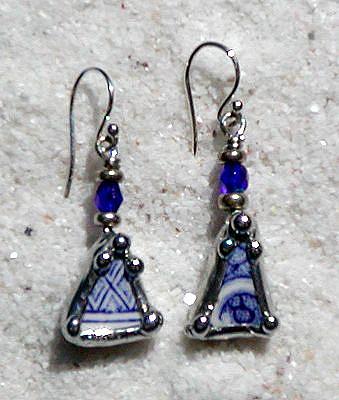
Broken China Earrings...not kitchen, but I had to share. 


 Teapot from the Atlanta Antique Gallery


  Tea Tray made with broken china at the blot Pennello Lane. This one just got added to my personal to-do list. 


India Blue tablecloth at Blithe.


 Tablecloth by Indian Garden Company, available at Not On The High Street. 


Who says Steampunk has to be brown?


There Never Was Such a Goose!

 
Such a bustle ensued that you might have thought a goose the rarest of all birds; a feathered phenomenon, to which a black swan was a matter of course -- and in truth it was something very like it in that house. Mrs Cratchit made the gravy (ready beforehand in a little saucepan) hissing hot; Master Peter mashed the potatoes with incredible vigour; Miss Belinda sweetened up the apple-sauce; Martha dusted the hot plates; Bob took Tiny Tim beside him in a tiny corner at the table; the two young Cratchits set chairs for everybody, not forgetting themselves, and mounting guard upon their posts, crammed spoons into their mouths, lest they should shriek for goose before their turn came to be helped. At last the dishes were set on, and grace was said. It was succeeded by a breathless pause, as Mrs Cratchit, looking slowly all along the carving-knife, prepared to plunge it in the breast; but when she did, and when the long expected gush of stuffing issued forth, one murmur of delight arose all round the board, and even Tiny Tim, excited by the two young Cratchits, beat on the table with the handle of his knife, and feebly cried Hurrah.
 In the past few days, I've learned a thing or two about goose.  In Victorian England, thousands of geese were marched from the countryside into the big cities in the month before Christmas.  They would be fattened one final time, then hung fresh in the butcher's windows just in time for the holidays.  Turkey, our modern favorite, on the other hand, was something of a delicacy.  Turkeys did not adjust well to the Old World, and were finicky, prone to illness.  Their feet were more delicate as well, and they were often fitted with special shoes to try and make the march into cities.  This means that the Cratchit's goose was most likely a very poor little creature, bought cheaply from a farmer and then fattened in their yard on what little they could spare, while the prize turkey Scrooge purchases for them was a massive feast, something only affordable by the elite and trend-conscious.  A princely gift for the family of his previously disregarded clerk. 


Now-days, though, the situation has reversed, and a buyer needs to be mentally prepared to spend more money for a 10 pound goose then you would a big turkey.  It's worth it.  Not only that, it's rich enough that everyone ends up having less.  Still, as frugal as I am, that was my biggest moment of self-doubt in our Yule experiment--will it all be worth it when we're scrimping to have this as our Yule feast? It was, in spades. Part of that cost is because geese DO NOT survive being factory farmed the way turkeys do.  They require much more care, and good conditions, so that means that higher cost means that you are 1) supporting a small farmer somewhere, and 2) buying a far more ethically-raised creature. 

Apologies for the poor quality of my phone.
The goose.  Proof I need a better roasting pan... Let it defrost in your fridge (will take 3-4 days), but bring to room temperature the day you're going to cook it.  Drain any liquid, and dry off the bird very well.

The first step I took was to pierce the skin all over.  I used a very sharp knife, but something like a shishkabob  might work really well too; the goal is control, getting through the skin, but not cutting into the flesh underneath.  Like a tattoo artist, it's a painstaking process, but after the first 5 minutes or so, you start to get a feel for where has deep fat (like trying to poke a marshmallow), and where you're directly over the flesh or bone.  Don't forget to lift the wings!  Those are long wings, with a big fat deposit hanging out underneath--I can see forgetting down there leading to a huge chunk of very greasy meat.

Next, I used a dry rub.  I looked at over a dozen sites trying to decide whether to brine or not(as I do with my yearly turkey), and the picture I started to see was that while you *could* brine, it made the goose much more greasy, and no crisp skin.  On the other hand, if you were using a wild goose, brining seems imperative, as the meat is much drier and darker(also making the cooking time significantly shorter). There will be some weeping you need to dry off before you put on a rub.

I used the spices I would have used in a brine in my dry rub:


Goose Rub:

1/2 cup Kosher salt
1T cinnamon
2 t. clove
2 t. cardamom
2 t. white pepper
1 t. fresh ground black pepper
1/4 home-made candied orange peel (the dry kind I made last January, not the sticky kind), chopped fine or run through a food processor.  Try to scoop up some of the citrus-flavored sugar that ends up in the bottom of your container.


Rub the bird, inside and out.  You might want to wear a glove for that, because even though a goose is smaller then a turkey, it's long.  Very long.  By the time I got my handful of rub all the way up to the neck I wasn't sure whether I felt more like I was aiding a delivery or looking for Narnia.

Holy neck, Batman!
Roast at 350 F for 2-3 hours.  This is key, and I'm very glad I did it:  Start the bird breast side up,  after the first 45 minutes, drain out the grease and flip it back side-up.  Another 45 minutes, do it again, so that it's breast-up, and put foil over the breast meat.  That first draining I poured out so much goose grease I had to stop and get another pie pan!  This will mean crisp skin all over, and no super-greasy meat, essentially a substitute for a spit back in the old days.  Watch closely after that second turning...let your eyes and nose tell you when it's done, and check by cutting down into the point where the leg meets the body--no pink in the juices, at all, and it should be fairly easy to tweak the knife and disjoint the leg. 

Don't throw that grease away, either!!!  That is schmaltz!  I wouldn't go so far as to serve it on bread the way some Ashkenazi Jewish families do, but it is wonderfully flavorful. Let it cool, strain it, then refrigerate or freeze it (I poured it into a large mason jar).  Use a little bit to fry up potatoes, or saute veggies...there's a ton of flavor, so you don't need much at all. 

There is a trick to carving goose,  you can find here.


Other recipes of the night:

Wild Rice Dressing

Note:  I put prunes in this, and didn't like them at all.  They made the rice very sticky and gummy....too rich. Everything else about it was good, but I omitted the prunes.


1 T. olive oil
1 onion, chopped
1 apple, peeled and chopped
Splash dry white wine or Fre
1 stalk celery, chopped
2 cups wild rice blend
2 t. salt
fresh ground pepper
2 t. summer savory
2 t dried parsley
1/2 cup apple cider vinegar
3 1/2 cups good chicken stock (preferably home made)
1/2 cup walnuts or pecans (optional)


Cook apple and onion in olive oil over medium-low heat until caramelized.  Deglaze pan with white wine, add celery, stir and cook for a couple of minutes while wine soaks into the fruit and vegetables.  Add rice and seasonings, and raise temperature, stirring well.  When you start to smell a slight toasty smell from the rice, add vinegar and stock.

Bring to a boil, then reduce heat, simmering gently for about 1 hour, then resting for 10-15 minutes.  Keeps warm well moved to a casserole dish in the microwave.  Toss toasted nuts in before serving.  If used as stuffing, rather then just on the side, wait until the last half hour of cooking.

I also made Lussekatter, Sweet and Sour Saurkraut, Brussels sprouts (since my kids don't like saurkraut), and roasted carrots and turnips in the hot roasting pan while the goose was resting.  A common recommendation to go with goose is a dry white wine, like Riesling, if you are so inclined(although Brussels sprouts seem to be notorious for not pairing with anything, so I'd avoid those).  

Had home-made fruitcake for dessert.

`A Merry Christmas to us all, my dears. God bless us.'
Which all the family re-echoed.
`God bless us every one.' said Tiny Tim, the last of all.

 Additional links:
Gordon Ramsey's take
A traditional Swedish Martinmas goose (PDF)

Who is this Escoffier Guy Anyway?


It is almost impossible to discuss late Nineteenth Century food without talking about George Auguste Escoffier. But why?  Unless specifically looking for a recipe for Peaches Melba, it is almost impossible to find specific recipes tied to his name. 

The reason lies in organization. 

Escoffier began his career at 13, as an apprentice in his Uncle's restaurant in Nice, France.  At the time, French cuisine was dominated by the ideas of Marie-Antoine Careme (June 8th, 1784-January 12th, 1833) who had served as head chef for the future George IV of England, Emperor Alexander I of Russia, and Baron James de Rothschild.  

Careme was the original chef to write down french cuisine.  He meticulously organized it, for example writing down sauces by "Mother" Sauce:  Bechamel, Veloute, Espagnole, Hollandaise and Mayonaise, and vinaigrette.  To this day, if you know how to make each of those sauces, you can make any other sauce based in European cuisine...they are all variations on those five!  He also was famous for breathtaking edible centerpieces (an important part of great dinners of the day), and for being the first to heavily illustrate his cookbooks, giving chefs an end result to aim for, rather then just directions. 

A menu in Escoffier's hand, from the blog Les Recettes de Lous la Vache
Escoffier took Careme's ideas, the ultimate in French cuisine for almost one hundred years, and improved them.  Instead of simply encouraging cooperation between portions of the kitchen, he seems to have been inspired by Edwardian modernization in other fields.  The kitchen under Escoffier became a well-oiled machine, meticulously organized to turn out dishes in courses, requiring a feat of communication and skill in the kitchen. This method was called Service a la Russe, and was impressive in that hot dishes were served pipping hot, and cold dishes cold, as soon as they were wanted, rather then the impressive display of previous generations, which made room temperature dishes more advantageous, since there was no knowing when diners would get to a particular item. It's also the basis of fine meals today, starting with an appetizer (designed to prepare the pallet for what will follow), then soup, salad, and so forth.  He was known for his great attention to detail, often working up menus personally, based on the tastes of the diners. 

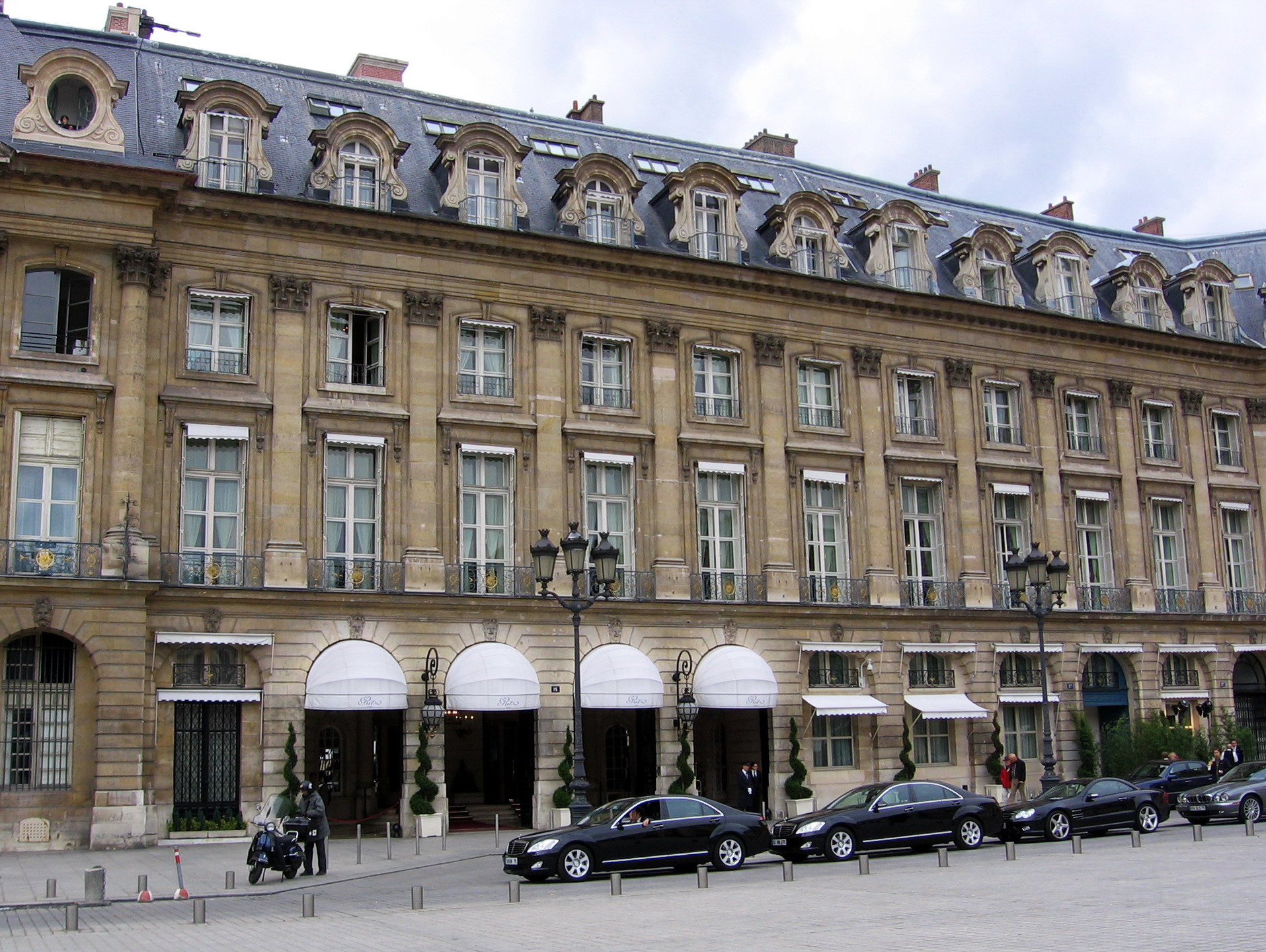
The Hotel Ritz, opened by Ritz and Escoffier in 1898
An excellent example of Escoffier's influence would be the menus served on the Titanic, as well as the famous hotel restaurants for the Ritz and Savoy hotels.  In fact, Escoffier and Cesar Ritz were friends for many years, both seeking to reform and modernize their professions.  This relationship may have also influenced Escoffier's invention of the a la carte restaurant, allowing diners to choose their meal for the first time.  In essence, the way modern food is presented, served, and handled in the kitchen, we owe to George August Escoffier.  An for this reason, many groups hold yearly dinners in his honor to this day. 


For a more detailed biography, look here.  

A translated compilation of Escoffier's writing is available from Amazon here. 

5 Mad Scientist Kitchen Gadgets I'm Still Waiting to See Steampunked

Antique Gallery here. 


We owe a lot of our modern kitchen appliances to the Industrial Revolution.  Stoves that could change temperature by the twist of a knob, potato peelers, canned foods, and cookie cutters are all products of Victorian or Edwardian ingenuity.  So why isn't there more Steampunking of the kitchen going on?  Sure, Steampunk Home and Kitchens.com have some great ideas for the overall kitchen area, but if I can type in a few quick keystrokes and come face to face with a beautifully steamed computer or laptop that looks like a music box, why is the same not true for some of my favorite toys?


5.  The Teakettle.

Worthpoint.com
Where would I be without listing this one first?  A staple in 19th Century households, and a vital belonging for Steampunks and Professor Elemental fans everywhere. 

From Craigslist for $185...talk about a bargain.
This is a case where the trappings are the fun part.  Most American and Western European kettles are simple and recognizable, but in Russia, it went a step further.  Due to the cold weather all year, many families had a treasured Samovar.  These never caught on in America, but were a common feature in Jewish and Slavic neighborhoods in big cities in the 19th Century. 

4. The Pressure Cooker

From Modern Pressure Cookers
These have been around for a very long time...since the 17th Century (check out a beautiful brass and silver Appert model here).  It was only in the early 20th Century that they gave up their heavy (and hopefully explosion-proof) look, with all sorts of interesting knobs and gauges and steam in exchange for the simplified light-weight versions popular for home canning.  Marketing also traded in the slightly stomach churning name of "Steam Digestor"...doesn't the sound of that just make you want to rush to put its contents on your plate?

If you plan on looking for old pressure cookers, though, be careful! Given their nature, they are dangerous stuff if not calibrated properly, or if time has damaged them in some way.  With those safety concerns in mind, this is one that if found might be better suited to a decoration, or becoming a component of a bigger(and low pressure) contraption. Not sure what to do with one, even if you had one?  Go here!

3. The Ice Cream Maker
1900 model from the Journal of Antiques and Collectables.

Patent for the small-scale hand crank type goes to Nancy Johnson in 1843.  According to the Journal of Antiques and Collectables, by the Civil War there were about 50 different versions of the bucket style machines, and they're still available today if you know where to look.
5 gallon churn attached to a 1926 Hercules Engine.
The concept is simple, and much less dangerous to tinker with then some of the other contraptions on this list:  The inner container holds ingredients, with a paddle to mix them, while the outer canister holds ice and salt, to bring the temperature below freezing.  The combination of the cold and churning creates the ice cream.  I'm fairly sure most steampunk tech-heads(would that make them steamheads?) can get some good ideas from there...


From HomeBarista.com
2. The Espresso Machine.

1901 gave us the Tipo Gigante, a machine invented by Luigi Bezzera to use steam to force hot water through the coffee grounds, hopefully reducing the time his employees took for their coffee breaks.  The result was fast, but bitter.  Desiderio Pavoni, who bought Bezzera's patent, experimented with temperatures and landed at the 192F standard for modern machines.  The Victoria Arudino models will blow your mind.
Exhibit A

 1. The Kitchenaid

Invented 1908, the H-5 home model came around in 1919. According to KitchenAid,
"...all stand mixer attachments will fit any KitchenAid Stand Mixer, including the original." This means that theoretically, one could find an original H-5 and put it to use. 


The H-5, according to DecoDan.com it sold for $189.50 in 1915, no attachments!
These things are essentially a decent little engine with kitchen bits attached...what isn't to love about that?  While there are various sites that make decals for them (and I wouldn't mind seeing a pretty copper one like my mother in law's with cogs on it), I almost wish there was a safe way to put a window in the side so that one could see the inner workings without  it becoming dangerous.  There are even people out there who custom paint them, and although I've been tempted on more then one occasion to try that myself with my plain white one, I'd rather not end up with the sort of paint I have handy in my food. 

Oh, well, one can always dream, can't they?

Real Tomatoes in Every Bottle!


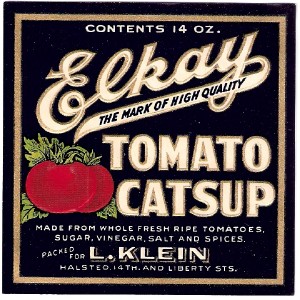
I tried my hand at ketchup making for the first time this past week and the results were interesting.  Two recipes:  The first was one of the first recorded recipes for tomato catsup (yes, there are other kinds...more on that in a moment) from Mrs. Mary Randolf's The Virginia Housewife: Or, Methodical Cook.

Happy Birthday Dr. Graham!

From Better Living Through Breakfast

I do not remember a single day my grandmother did not have a package of graham crackers in her kitchen.  If you were hungry between meals, the choices were that or a banana.  I remember asking her once why she always had graham crackers, and her response was that "they were good for children".


Click here to read about how they're made.
Once I had children of my own, I honestly wondered why.  No graham crackers on the market, other then the Nabisco Honey Maid brand still contain graham flour, and even those are less then exemplary, the primary sweetener being high fructose corn syrup (rather then the following bit of namesake honey), and hydrogenated cotton seed and soybean oil, the cheapest source of food-grade fat.  On par with a packaged cookie.


So what was the purpose of graham crackers?  Why were they "good for children", and what in the world is graham flour?

...and orangutans, a breakfast cereals, and fruit bats, and large chunks of oatmeal, and bananas, and raisins, and koalas, and blueberries...


It's always fascinating to see how the Industrial Revolution changed even the most basic aspects of our modern life.  Before, I've mentioned the affect it had on when we had our meals...leading to the creation of teatime, to fill the gap that was created.  Today, though, I'd like to discuss how it has affected what we eat for a given meal, specifically breakfast.  Because until 200 years ago, there really was no such thing as breakfast cereal.

There is Steam in My Kitchen!

If you are unfamiliar with the concept of Steampunk, Scifipedia explains it rather succinctly as something that, "is set in an era or world where steam power is still widely used—usually the 19th century, and often set in Victorian era England—but with prominent elements of either science fiction or fantasy, such as fictional technological inventions like those found in the works of HG Wells and Jules Verne .."

Of course, there's a lot more too it then that.   To me, as (obviously) a fan of the Victorian and Edwardian, it speaks of a time when there was still a possibility for adventure, where corners of the world still lurked undocumented.  It makes one wonder what might have been, without the advent of plastics, with style and manners retaining a softer look.

Of course, promptly after my little  mental airship into fantasy, the cook in me asks, what about the food?  I think there are a couple of ways someone might go on this.

The Gimmicky:

This is what we get into a lot when I see this topic discussed on various Steampunk boards.  It is, to me at least, the equivalent of taking just any old brown clothing item, tossing cogs and watch bits on it, and calling it a day.  Not that sepia and cogs aren't cool--this cake has been making the rounds online and is very well done, to say the least.  Huge, Rube Goldberg-esque machines also don't do the trick for me.  Technology has always been about doing something faster, easier, or more efficiently. 

If you want to discuss Victorian diets and food gimmicks, that actually leads in some interesting directions, particularly since that era invented the concept of "health food".  The Reverend Sylvester Graham invented the the graham cracker, convinced that a diet high in fat led to sexual excess (which, according to Snope's, was actually one of his lesser food eccentricities).  A similar eclectic vegetarian and Seventh-Day Adventist, bored with the non-meat oriented options for the Victorian breakfast table, developed corn flakes.  Or, you have salisbury steak.  The good Dr. Salisbury firmly believed that "vegetables and starchy foods could produce substances in the digestive system which poison and paralyze the tissues and can cause heart disease, tumors, mental illness and tuberculosis."

The Historic:

I have a soft spot for this one.  English cuisine traditionally gets a bad rap, but if you go back to Georgian period cooking, or look at the French-Inspired haute-cuisine of the turn of the last century, you find a lot of flavors that have become classics (with many people clueless about how delightful the original was), or have in a mass-produced age fallen by the wayside for no good reason.  For a crash course in 19th Century cooking, I'd strongly recommend some of the links in the sidebar, as well as the book Last Dinner on the Titanic, which provides an excellent cross-section of fare for First, Second, and Third class passengers(the last of which, incidentally, eating more nutritiously then the average modern American home).    I would also recommend some of my recent posts, such as that about Peaches Melba. 

The Mad Scientist:

Yes, there is a time and place for steam in the kitchen;  what enthusiasts often forget is that there are literally hundreds of kitchen gadgets that we have compliments of the Victorians!  The can opener, 1858(with cans first coming into use during the Napoleonic war).  The first egg beater, invented in Rhode Island in 1870.  Gelatin desserts and aspic creations meant hours of slaving over a hot stove, and immense talent in the chef.  Scientists started experimenting with pressure cookers clear back in the 17th Century, billed as, "A New Digester or Engine, for softaing bones, the description of its makes and use in cookery, voayages at see, confectionary, making of drinks, chemistry, and dying, etc.", but started to really come into it's own with industrial kitchens.  Personally, I can't think of a better example of Steam in the kitchen!

The Exotic:

Yes, traditional 19th Century food is often seen as boring, but it really was an age of discovery.  Foods began to circle the globe.  Curry and exotic spices which hadn't been common since the Middle Ages began to make a regular appearance in European cooking.  Foods like tomatoes and potatoes from the Colombian Exchange circled the globe with Caucasian colonists, permanently changing the face of food.  There were also bad affects--particularly when it came to the mass-produced, nutritionally deficient food that became desired as a symbol of position and upward mobility under Colonial Rule. The same thing also occurred with American immigrants, since cooking the "American Way" was considered a necessary part of fitting in, leaving old customs, and ways of dressing and eating at the door as much as possible. 


So what can be taken from all of the above?  I personally believe that Steampunk Food should be like Steampunk literature--taking what was in the direction of what might have been.  Instead of trying to slap "steam" on top of something already in use, or clinging to historical authenticity, there are some questions that we cooking enthusiasts should be asking ourselves:

What was the big, new, thing back in the day?

How would it have been different with quicker global travel, a la airship(the things that were amazing treats on the Titanic are an excellent resource for this)?

What would a crew have eaten that could cover the globe in a month or so?  Like tattoos told the story of where a sailor had been, what flavors and ingredients would have been popular had shelf life not been such an issue?  Would they have remained strange and lower-class, or been embraced by chefs like Escoffier? 

With a little research, the possibilities really are endless!  Not only that, it's a great reason to start to cook from scratch, and really come to understand the degree to which we stand on the Victorian's shoulders in the kitchen, for better or worse.

Dame Nellie Melba

Melba....Melba...how do you know that name, and why is it tied to food? 

Meals for the Bachelor

I usually talk about very women-oriented stuff on here...today is an exception.

One of my favorite sites these days is The Art of Manliness.   No, it's not geared towards me, by any stretch of the imagination.  Instead, this site generates a feeling that is the online equivalent of the now extinct Men's Lodge,