Showing posts with label frugality. Show all posts

Back On The Trail and PCOS


All previous excuses aside, it has been darn hard to get back in the swing of my blog since our move back to CA.  I am very sorry!


While I've talked about how it was a crazy two-part move, my working again, etc.  There's been one more thing that has put a big old wrench in how I run this blog, and led to me needing to pause and think about what I want to do: last winter I was diagnosed with PCOS, or Polycystic Ovarian Syndrome.  Now, one might think that with the word "ovary" in the name, the big issue is with reproduction...and for some women, this is true.   Many women have very serious infertility issues with this condition.  Since my partner and I are planning on no more children(or, possibly, no more biological children), this is not a big problem for me.  However, it is an endocrine disorder, meaning that it messes with hormones, and from there can cause all sorts of weird (and often seemingly unrelated issues).

In my case, I am insulin resistant, and seem to have some major issues with carbs(especially white sugar and flour...the latter to the point that I suspect an allergy might be at play as well), as well as some physical issues that can cause me some embarrassment(among other things, male-pattern hair thinning and hair growth other places that women don't usually have issues, as well as bouts of pubescent-level acne).  I have also spent the last nine years, pretty much from the point where I could no longer afford to follow a rather radical raw-foods vegan diet as a college student, overweight, often seriously so.  Nothing seemed to work, including eating very healthy, and exercise often left me sick and in pain rather then energized the way it should. Left to my own devices, I slept all the time. 10 or more hours of sleep and I'd wake up tired--I was that worn out! As you can probably imagine, this was hard to cope with, especially because a common response from others was the assumption that I wasn't trying hard enough, or saying I was sick for the attention.  There were many times when the number of small things (not fitting clothing I did three weeks previously, issues with my hair being particularly limp and lifeless, being tired and even having muscle pain all the time) left me with not enough spoons.  This blog was a godssend.  It helped me stay sane, and kept me moving on days where I didn't want to get out of bed.

Now, here we are...diagnosis, research, major diet changes, medication, and a little over one hundred pounds lighter then I was when I found out I was pregnant with my son three years ago!  I still have bad days...ones where I don't want to talk to anyone, or leave the house.  Those, thankfully, are reducing.  And when I get them, I usually have more resources and reserves to cope.

With this blog, though, I have a quandary.  The Victorian stuff and retro American cuisine stuff I tend to focus on is PACKED with the very things I can't eat, especially white flour and sugar.  It's everywhere!  In the bread and baked goods, in the jam and marmalade and curd.  What should I do?  I literally can not eat those anymore, and let me tell you, that is tough in American culture.  Will it still be GG's Kitchen if I don't do those, or if I focus on healthier alternatives that I, personally, can consume?  While I'm still happy to provide links elsewhere, this would mean a major overhaul of the sort of content I provide.  I would love thoughts and input.

If I were to get rid of those, then the sorts of baked goods I would feature would be primarily wheat-free(often gluten free).  They would rely on other cultures, not Central Europe, U.K., and American history.  I would also look for things that used honey as a sweetener(especially raw or unprocessed), agave nectar, and yes, even sweet-leaf and other more natural artificial sweeteners (nothing creepy like SweetNLow). I'm finding that now that my sweetness threshold has lowered, many mincemeats and raisin fillings require no additional sweetener at all.  I would love to hear input about this.  Please leave your thoughts, if so inclined.

In the spirit of these changes in my life, I would like to share our new go-to trail mix at home.  I've been finding that a lot of mixes use sweetened dried fruit, very cheap chocolate or other candy, and nuts that smell past their prime.  Savory mixes often have little crackers and hydrogenated oils. It blew me away discover just how fast and easy it was to make my own, with exactly what I want in it.  I find that it averages 12 snack backs if you use a half-cup measure, and ranges at around 20-35 grams of carbs, about the same as most slices of bread, but could be higher if you use more fruit, or cheaper quality chocolate.

GG Kitchen "Back One The Trail" Mix

1 lb. Nut mix.  Get something you like, but I've found a mix better then one nut.  If you want them fresh, get raw nuts and either put them in as-is, or roast them in your oven at around 350F for 10-15 min (watch them closely).  Stir often, and pull as soon as you're smelling toasty nuts.  Cool before mixing with the other ingredients, so that you don't melt the chocolate.  You can dry roast them, or toss them in a little butter and salt first(add cinnamon or ginger for a real treat), or even with soy sauce and sesame oil for a savory version.

1/2 lb fruit mix.  I prefer unsweetened fruit, as that's a lot of white sugar getting added.  Raisins, dried pit fruit and apples cut in small chunks, stuff you have dried yourself.  If you can find them, you can even add unsweetened dried cranberries if you have other very sweet fruit and it can be a nice tart tang.  If you want to do a veggie blend, something like Just Tomatoes (including their other veggies) is awesome!

One good quality 2-4 oz. bar dark chocolate, if going sweet(maybe even if you're going savory...chocolate and chilis make a winning combo).  What do I mean by good?  High chocolate content:  Something like Hershey's is mostly sugar and other ingredients...that's why it tastes so waxy.  You want chocolate that would be bitter eaten alone, but the fruit and other ingredients sweeten.  It is worth spending the money, trust me.  And since it's worked into the mix, a little goes a long way.  Something like this , although if you can, looking for terms like organic, sustainable, and fair trade are good for all the same reasons they are for a cup of coffee. 

Other things that could be added sweet or savory:

  • Unsweetened dried coconut.
  • Sun-dried tomatoes
  • Cut-up beef jerkey
  • Some sort of seed cluster similar to this over at Mark's Daily Apple.
  • Nori seaweed flakes.

Shampoo, or Lack Thereof

From the Hair Archives
Normally, I stay roughly on Kitchen topics at GGK, however, my friend Thalassa over at Musings of a Kitchen Witch has been talking lately about other ways then shampoo to keep hair clean(you can find her posts here and here).  Since I no longer use traditional shampoo either, she asked me to talk about what I do as well.

Now, shampoo as we know it, didn't exist until the 30's.  While some shampoos began to hit the market in the early 1900's, they caused alkaline reactions, leaving a gray film on hair.  Dr. John Breck invented the first PH-balanced shampoo, and the companies ad campaign, featuring Breck Girls, lasted well  into the late 70's. 
Olga Armstrong, the first Breck Girl
This led to a cultural expectation of frequent hair washing., and the idea (at least in America), that oil in hair means that it's dirty.  I grew up in a family in which everyone washed their hair every morning, and my grandmother told horror stories about her years as a school teacher, and trying to get shampoo for one of her students who was teased for her stringy hair, only to have the child's mother say it "looked too fly-away" and put grease on it!  Even so, my grandmother would get her hair done at the hairdressers once a week, and usually only washed it mid-way if she had to, as it spoiled her look.

Cleo De Merode
So what did our ancestors do before the shampoo revolution?  According to this Victorian care guide, the solution was similar to many today who find that, unless their hair gets some foreign dirt in it, it needs no soap at all.  The guide stresses the importance of using a boar's bristle brush, and keeping it immaculately clean (even going so far as to suggest cleaning it with a diluted ammonia solution periodically).  It also suggests using a Castile soap (which has olive oil as a base, rather then the very harsh lye soaps which were the period alternative--no wonder people didn't use them on their heads!). The basic outline of their routine is to wash hair once per week.  Use Castile soap if one's hair is oily, but if it's dry, an egg yolk is a good alternative. and is a common cleaner for modern no-shampoo folks.  Hair was supposed to be brushed every night, the old "100 strokes" idea, which with a boar's brush and gently done, pulls oil down the length of the hair, keeping it from getting oily up at the roots, and drying at the base.  It's worth noticing, too, that it's suggested to rub the hair with flannel after, I'm assuming to soak up any additional oil the hair doesn't need.

If you want a great example of someone trying this method out, The Gibson Girl's Guide to Glamor has a very interesting post on the matter. 

So what do I do?  As an adult, I found that my hair did much better only being washed every second or third day (often depending on factors like how dry the weather is, where I am in my muenstral cycle, and stress).  While hair experts often disagree about how often is too often, many say that we wash our hair too often now, stripping it of it's natural oils at a rate that encourages the body to overproduce oil to catch up.

Via. Rapunzel's Delight 
A few years ago, I tried using no shampoo at all, and found it doesn't work well for me, personally.  My hair is baby fine, thin, and prone to being oily(especially at that time of month), and so all it did was slick to my head.  Someone with dry hair would have completely different results, though, and my friends who have tried this sort of experiment with "frizzy" hair find they often suddenly have curls.


More recently, I became interested in Castile soap and switched to Dr. Bronner's Magic Soap, available at health food stores, and now at Target.  The label is truly amusing...it contains everything from recipe ideas to scripture references, and reads like a 19th Century cure-all peddler's schtick.  However, I have to say, the stuff works.  I have switched to diluted forms of it for hand soap and cleaning, too.  Direct from the bottle it is very strong, and will leave your hair stripped and tangled...I strongly discourage using it that way!

My Shampoo Recipe

3T-4T Dr. Bronner's Soap (whatever scent you prefer...eucalyptus can help with dandruff, though)
A few drops of Essential Oils
1T Extra Virgin Olive Oil

Add to bottom of a large empty shampoo bottle.  Fill almost to top with filtered water.  Shake every time before use...this will leave a lot of foam on top that will make it easy to lather.

I use a rinse after that is Rosemary tea, and about a quarter cup of apple cider vinegar. Since the Castile soap is gentle, but not PH balanced, it makes up for that.  The Rosemary is because I have dark hair, and am prone to a bit of an itchy scalp in winter.  For other suggestions, go to my second link from Musings of a Kitchen Witch above.

Even though my hair is currently very short, I also brush it regularly.  I find that it's more important to stimulate my scalp then anything else...and my hair is much healthier with more body.  Like the Victorians, get a good brush and clean it often!  Also, if you try this, expect to need less product...a lot of our modern hair products are designed to make up for removing our body's natural oils.

The Amazing Seven Sutherland Sisters!
Did you notice how much olive oil I put in?  That has reduced how oily my hair is, ironically enough...it also helps to calm my scalp down with dry winter weather.  My husband's hair is not as oily as mine, though, and responds better with just a few drops of olive oil (his hair has become much more manageable, as well).  Another interesting side effect is that I no longer have little eczema patches on my back and arms, something I've battled for years!

What about those days when I don't have time to wash, or I'm almost to a shampoo and my hair is looking nasty?

Corn Starch Dry Shampoo

1 cup Corn Starch
Essential oils to scent the hair, or dry herbs (will scent it much more slowly...I like mint)


Mix together and store in a small container in the bathroom.  To use, take about a tablespoon of the cornstarch, and rub it all over your scalp.  Don't worry about ends so much...just where it looks greasy.  Then brush, brush, brush.  It takes about 5 min to not look like a ghost.  You will be surprised at how full your hair feels (this is also a great thing to do before trying some of those old hairstyles).

So there you go!  This is what works for me, personally.  If you have something you do and love, please share it in the comments!

Apples, Pumpkins, and Turkey Stock


Starting to feel better...thank you everyone who has sent well-wishes, thoughts, prayers, etc, my way!

Normally, I'd break this up into three or four posts, but this is all fall-pertinent stuff, and now we're heading into winter, so I'm going to do one big post today on what's been going on in my kitchen.


Wild Gathering

I've had some very interesting experiences this fall.  Since I currently live in a more rural area, I noticed that there are a number of abandoned apple trees around my town.  They generally look around ten years old or older, and haven't been pruned in a very long time, which means that I often was gathering apples from what appeared to be water shoots from the graft, not from the main tree.  This led to an interesting discovery, which given the climate here makes sense:  most of the apple trees in question seemed to be small, tart, starchy apples for cider.

I also had my very first rose-hip gathering experience.   I had no idea they had such a great scent and flavor!  Unfortunately, the hips I'd gathered and seeded went bad while I was ill, and so that is something I'll need to try again next year.

Another goal for next year would be to try making crabapple jelly.  I used to wonder why old towns in Utah and Idaho had big, old, crabapple trees..after all, all they seemed to do was drop fruit all over the yard and attract deer.  It would seem, though, that they are an ancestor of many modern apples, and, while sour, are very nutritious!  Certainly something to try, although given their high vitamin C content, I want to do my homework and see if there's a tasty way to use them without cooking them. 

 Apples

So, what does one do with a plethora of small, starchy apples?

The blog Bleeding Espresso caught my attention with a recipe for apple sauce, that can be cooked down longer into apple butter.  I left mine on the stove top a bit long, and so never tried the applesauce stage, but the recipe worked great for me.  Since I don't have a food mill, I used a blender, and there were no peel bits left...very thrifty!  While she simple quarters the apples, though, I went ahead and cut the center core out, since apple seeds contain a cyanide compound called amygdelin.  Better safe then sorry!

This apple butter recipe also calls for some vinegar, which led to a very interesting flavor.  I like it, as it seems to get away from the "overcooked" flavor of some apple butters, brightening it.  My husband jokes that it reminds him of an apple catsup, and wants to serve it next time we have pork chops!

Pumpkin

I found a recipe that is one of the simplest things I have ever done for amazing results.  We went to a local pumpkin patch with family right before Halloween, and my Father In Law bought us some little pumpkins called Sugar Babies.

Now, I've tried making my own pumpkin puree before, and it was a disaster.  The big halloween pumpkins are bred for easy carving, which means thin walls and a rough, pulpy texture.

Not these!  I can't tell you how excited I am to be able to make my own...no more expensive cans of pumpkin!

 Using a recipe from Cooking Like a Goddess, by Cait Johnson, I cut the pumpkins in half, and roasted them for 45 minutes in the oven.  The seeds were easy to scrape out, and then digging deeper scraped the flesh right out of the peel.
 I pureed it in small batches.  This took time and plenty of pauses for stirring, but left a very creamy texture.

 Look at that!

Final product:  I should have left more headspace, though, to freeze it(I didn't want to loose that beautiful fresh color).  No broken jars, thankfully, but I had some popped lids.  Those two pumpkins made three and a half jars of puree.

Now, I can use it to make pies, pumpkin butter, add it to cream sauces, soups, fillings for ravioli...you name it.  One of the simplest recipes for the greatest reward I have EVER made.

Turkey Stock

We did Thanksgiving slightly early at my house this year.  I have younger siblings who live nearby, and since we all go our separate ways for this holiday, I thought that it was a great excuse to do a turkey early, sort of a test run.

I do two stocks:  giblet stock while the turkey is brining (if you don't know what that means, go here, you will thank me!), and a stock with the bones and carcass after the meal for soup, etc, later in the week. 

Giblet Stock

The organs that come inside the bird(gizzard, heart, liver, etc.) Gently salt, pepper, and drizzle with olive oil, then roast in the oven at around 350-375 until browned nicely.

Put in a crock pot with:

Carrots,
Celery,
Onions,
Apples,
Parsnip peels,
Bay Leaves,
Whatever seasonings you are using on the turkey.

It takes about 4-5 hours on low to make a rich brown stock.  I just leave mine going overnight, then strain it.

This stock makes for great gravy.  Just start with a roux (equal parts butter and flour) cooking in the pan.  When it's golden and fragrant, slowly stir in stock, then let thicken.  Season to taste, and add the turkey drippings when it's done.  Other great additions are caramelized onions and mushrooms.

Turkey Stock

Bones, leftover giblet stock, any scrapings from the bottom of the pan, and whatever herbs and aromatics you put inside the bird,

Peelings and bits from your meal, I had:
Onions, garlic, celery and carrots,
Parsnip peels,
Apple peels
Mushroom stems,
Lemon halfs
Leftover roasted pumpkin, garlic, and onions that had been a side-dish


*Whew*  And there you go!  Thank you for patience, everyone.  I hope that made up for it!

5 Reasons Every Vintage Foodie Should Try Bountiful Baskets

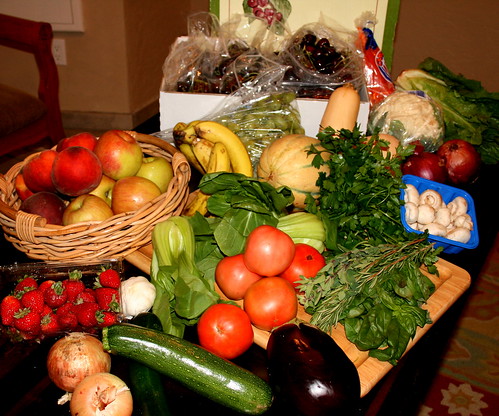
5)  It's easy.  If you aren't familiar with Bountiful Baskets, here's the deal:  it's a co-op.  Every Monday, you sign in on the website, and place an order.  There's a small charge the first time you do it, so that they can buy a new pair of baskets.  Other then that, though, it's the same every week--$15 plus a small handling fee for a regular basket, $25 for organic.  There are sometimes additional items you can purchase, too, like a Mexican basket, or bread.  You print out your number, and on the listed time and day, go pick up your produce.  You're asked to come early and help when possible, at least every two months or so. Try it once, get over the "new and scary", and you'll be hooked.

The Bountiful Basket Facebook Page

4) It's frugal.  While I buy a couple of vegetable items at the store or farmer's market (berries when in season, the holy trinity of onions, celery, and carrots), my single, basic basket is enough produce for our family of four(two adults, a Kindergartener and a toddler) for an entire week, often with some to spare. If any leftovers start getting too ripe, I make jam, or put them in the stock pot.  Everything gets used.  For the first time in a very long time, my kids are able to eat fruits and veggies whenever they want a snack.  About $50 worth of produce for $15.

A basket posted by the author at Bunches and Bits--check out everything she did with it!

3) You support local farmers, and small business. A lot of the produce at the grocery store is shipped from half-way around the globe to get to your table.  A bag of grapes from Chile are more expensive, require more chemicals to get to you without spoiling(often ones that are illegal in America), and has required the use of a lot of fuel(traveling by boat, truck, etc,etc).

A lot of effort goes into making the produce travel as little as possible.  Since I live in Idaho, I often get local Idaho potatoes, fruit from Utah or Oregon, and veggies from California, but if you're in a different part of the country, you might get a completely different basket.What you get, though, has to be in season because of the effort for local produce.

This message brought to you by the Institute for Responsible Technology.


2) It helps you eat seasonally.  Farmers grow different varieties depending on the market, and when it comes to shipping long-distance, fruit and vegetables that have a lot of flavor often lose.  Eating seasonally helps make it easy to figure out what will be fresh, ripe, nutritious, and full of flavor.  It has been the way our ancestors ate for millions of years.  It also seems to encourage my children to try new things(can't eat nothing but apples if we only have them in fall), and makes when we DO have a particularly loved fruit or vegetable that much more special. 

To say The Toddler is excited for apple season is a bit of an understatement.  World Community Cookbook.

1) It will make you grow as a cook.  Signing up for Bountiful Baskets has forced me to plan the way we eat differently.  It used to be that I would plan out meals, weeks in advance.  Now, I wait to see what I got in the basket, then go shopping later on Saturday, with a week's plan based on meals that compliment my produce and make the best use of it.  Instead of eating variations on the same meals, I look for ways to adjust favorites, and learn technique that is applicable across the board, rather then a set recipe.  For example, I got another head of cauliflower this week, and still haven't used up all of the last one--it's time to look around online, flip through my vintage and historic cookbooks, and rise to the occasion! 

Spicy Cauliflower with Sesame from 101Cookbooks

Plastics Are Ruining my Look

From CarveWright.com
There are all sorts of good environmental reasons to cut back on plastic:  The fact that it's made from petroleum (and all ensuing complications) are the biggest ones.  Cut down on plastic consumption, and you cut down on the amount of oil you use.  There are also some scary health reasons (phthalates, DEHA, and BPA, I'm looking at YOU).  Sadly none of these have led to me cutting back on plastic touching my food.  I think I know have a reason that might, although it pains me to admit it:  aesthetics.

Yes, you read that right.  Plastic keeps my kitchen from looking suitably retro-Victorian for my taste, and so it has to go. I'm still trying to figure out exactly what that says about me as a human being.

But what should be used instead?  I honestly started out having no clue...my entire life disposable plastic has been a standby in the kitchen.  Many switches though are simple and easy...and are part of a scheduled overhaul in my kitchen.


Instead of plastic shopping bags:

Buy some reusable bags or baskets.  I got some three years ago and while they've lost the flat bit for the bottom, otherwise they're still going strong.  Because they're sturdier, the ones that are about the same size as plastic bags actually hold three plastic bags worth of groceries.  The only real difficulty is making sure they make it to the store.

Or, better yet, sew your own bags.  If you have old denim or odds and ends of fabric you love, this is a simple way to use them, even if you don't have the most sewing experience.  I've even seen totes made out of items that would otherwise be thrown away, like crocheted grocery bags or sewn together juice pouches. 


Instead of plastic containers for leftovers:

They even come in smoothie size.
Use glass!  A big part of what got me thinking about all of this recently was a post over at Months of Edible Celebrations where the author mentioned that blenders were designed to also fit mason jars, so that cold or room temperature items could be stored in the same container they were blended in!  This blew my mind...apparently it was a common practice 40 years ago, and here I was MOURNING the loss of my Magic Bullet in our last move--a very expensive bit of machinery to do the exact same thing I could be doing with my regular blender and some glass canning jars.  

If you have small children like I do, camp plates are also your friend.  They've been a staple in European nurseries for ages for a reason.


Instead of Sandwich Bags:

When packing lunches, there are a number of nice reusable lunch containers on the market.  I confess, I like brown paper bags best.  They can be recycled, I won't cry if they're lost or tossed instead, and they make great craft projects and incubators for pies.  As for what goes in the bag, our great grandparents would have wrapped their sandwich in wax paper.  That applies to other kitchen items, too...Alton Brown swears by storing cheese in waxed paper in the fridge.  That way the live bacteria can still breathe.

Storage: 

Glass or metal kitchen canisters have a great vintage look, and make it easier to buy in bulk.  If you can't find a good set, you can get a plain glass or ceramic set and add pretty decals.  I'm looking forward to an eventual new set, since mine are pretty hand me downs, but have seen better days.

Labels at The Project Girl
Another common staple until recently has been the breadbox.  Before plastic bags and additives kept bread fresh for days, even weeks, after it was baked, it had a fairly limited shelf life.  Breadboxes were designed to keep it as fresh as possible while keeping vermin (and/or small children) out.

There are also some ideas that can cut back on messy things headed for the trash(making it less likely you'll need plastic liners to stay sane).  For example, it is simple and easy to build a compost heap if you're lucky enough to have land.  By putting your biodegradable kitchen refuse (but not animal parts like bones) in a crock that gets dumped on the compost pile, you cut down on your trash, and add a lot of nutrition to the heap.  Even better if it's vegetables that were used for stock, since those are already partially broken-down!  Victorian kitchens also often had specialized crocks for things like a sourdough start, pickles, and sauerkraut...all of which do best at cool, but non refrigerated conditions due to their live cultures. 

One other potential problem area is plastic wrap, which I personally use everywhere.  Julie, at Towards Sustainability has written a great article on that issue, pointing to baking paper, foil, and cellophane as alternatives. 

Anyone else have other ideas to throw my way?

Real Tomatoes in Every Bottle!


I tried my hand at ketchup making for the first time this past week and the results were interesting.  Two recipes:  The first was one of the first recorded recipes for tomato catsup (yes, there are other kinds...more on that in a moment) from Mrs. Mary Randolf's The Virginia Housewife: Or, Methodical Cook.

The Lovecraftian Kitchen: Organ Meat.


Three months ago, I decided it was time to try a new sort of personal challenge.  Like I mentioned back in May, I think one of the problems with a lot of "back to nature" diets that include meat is the insistence on just eating the prime cuts of animal muscle that are popular in the regular American diet.  What about everything else that we don't normally eat?  All the "gross" bits that most Americans have never eaten in their lives (so how do they know it's disgusting)?  This is where varied nutrition lies, not in steaks and pork chops.   I'm not exactly prepared to go Andrew Zimmerman and start eating everything from blood to bugs, although who says I couldn't in the future?  Insects, just like any farm animal, can be kept in conditions that are either clean or dirty, but unlike large mammals, they can easily be raised in a small home(meaning you are taking charge of your protein source, even if you lack space), and are packed with nutrition--the only caveat being our cultural "cooties" about munching on grasshoppers or mealworms.  

First, though, I needed to start simple.  That meant the organs that are readily available in my local grocery store: liver, kidneys, heart, tripe, tongue.

...and orangutans, a breakfast cereals, and fruit bats, and large chunks of oatmeal, and bananas, and raisins, and koalas, and blueberries...


It's always fascinating to see how the Industrial Revolution changed even the most basic aspects of our modern life.  Before, I've mentioned the affect it had on when we had our meals...leading to the creation of teatime, to fill the gap that was created.  Today, though, I'd like to discuss how it has affected what we eat for a given meal, specifically breakfast.  Because until 200 years ago, there really was no such thing as breakfast cereal.

Two Chicken Week--Part 2, Pies and Casseroles

Two Chicken Week Part 1 here. 

 As long as there have been ovens, somebody, somewhere, has tried to invent something that would let them A) reuse leftovers that their family didn't want to eat, and B) make the evening meal and then walk away.  Meat pies and casseroles fit the bill.

Victorian Christmas Pie from the excellent Historicfood.com

Citrus Season!

So many new projects I've been trying over the past few weeks with all the fresh citrus getting shipped up from Florida and Southern California. 

The big winner so far?  The sweet, tangy, and pleasantly bitter Three Citrus Marmalade from the Blog, Food in Jars.  I've never made marmalade before, so the pictures were very helpful.  I was shocked by how easy it was.


The Two Chicken Week--Part 1

Need a go-to menu for a week when money's tight?


Back in the day, before modern food preservation, you didn't really have recipes that called for, say, 5 chicken breasts.  What would happen is that you'd roast an entire chicken or cut of meat (or make it into a dish).  If there were leftovers, they'd get made into a pie, what was left after that became soup or stock.  Whole poultry or cut used, start to finish, in 4 days, tops.  In the spirit of that tactic, I bring you my use-everything tactic, for those tight budget weeks.