I've been getting a lot of summer vegetables in my Bountiful Basket this week, which rather odd to me. All I can guess is that it means that the cheapest produce available is from Mexico at this time of year. We are just starting to get the first cucumbers, radishes, asparagus, and strawberries from California, though...so spring is certainly on the way!
Odds and Ends, and slightly Spicy
Lamb and Pork bones
Chicken bones leftover from hot wings
The Usual: ends and peels from carrots, celery, onions, and garlic.
Red and green pepper tops
Eggplant tops
Hot pepper and pickled pepperocini tops
Lots and lots of onions, in red, yellow, and white

A Chinese vessel, sailing by.
A bridge with three men, sometimes four,
A willow tree, hanging o'er.
A Chinese temple, there it stands,
Built upon the river sands.
An apple tree, with apples on,
A crooked fence to end my song.
It's no secret that I have a love affair with Steampunk and a Victorian aesthetic. My husband, on the other hand, is very fond of the simple elegance of Asian (particularly Japanese-inspired) furnishings. Where do two such opposite tastes combine? Victorian Orientalism, of course.
Starting in the 18th Century, Orientalism was a term used to describe the study of the East, most usually referring pretty much to any part of the globe that wasn't Europe or the Americas, particularly China, Japan, and other parts of East Asia, but also extending to India, the Middle East, and Northern Africa. Different areas had their own, unique highpoint with European culture, leading to all sorts of cultural offerings based on a romanticized idea of that particular land. Orientalism moved waves, starting with fascination with the Middle East and India, and by the end of the 19th Century exemplified by the story of the Gilbert and Sullivan Operetta, The Mikado.
As an aside, the 1999 movie Topsy-Turvy deals with just that subject, focusing on the eccentricity of the author and composer, as well as the difficulty of the original cast in grasping an attempt (shocking for the era) to make the operetta in question actually Japanese in flavor, rather then classic theater tropes of the day, including ethnic stereotypes, dressed up in a new wrapper(and yes, Miss Sixpence-please did, in fact exist, although unfortunately little to nothing is known about her).
Back to China. The famous Blue Willow Pattern shown at the top, along with its famous little poem, is actually not a Chinese pattern, but was invented in Shropshire in 1780. Minor changes have been made by various makers, leading to a story sprouting up about a pair of star-crossed young lovers, who are eventually turned into the birds at the top of the plate.
Blue Willow China had a falling out of popularity in the later half of the last Century, but has now come back, stronger then ever. A lucky thing for those like myself, who enjoy the ease with which it can mix and match with virtually anything, being dressed up or down as needed.
Here are some great ideas for using blue and white china, as well as mixing Orientalist ideas into the kitchen:


Blue Willow in the Butler's Pantry via Country Living...great way to mix up themes and colors.

A great example of a more eclectic and quirky collection, compared to above. From House to Home.
Broken China Earrings...not kitchen, but I had to share.

Teapot from the Atlanta Antique Gallery

Tea Tray made with broken china at the blot Pennello Lane. This one just got added to my personal to-do list.

India Blue tablecloth at Blithe.

Tablecloth by Indian Garden Company, available at Not On The High Street.
Who says Steampunk has to be brown?
 |
| William McGregor Paxton, The New Necklace |
Starting in the 18th Century, Orientalism was a term used to describe the study of the East, most usually referring pretty much to any part of the globe that wasn't Europe or the Americas, particularly China, Japan, and other parts of East Asia, but also extending to India, the Middle East, and Northern Africa. Different areas had their own, unique highpoint with European culture, leading to all sorts of cultural offerings based on a romanticized idea of that particular land. Orientalism moved waves, starting with fascination with the Middle East and India, and by the end of the 19th Century exemplified by the story of the Gilbert and Sullivan Operetta, The Mikado.
As an aside, the 1999 movie Topsy-Turvy deals with just that subject, focusing on the eccentricity of the author and composer, as well as the difficulty of the original cast in grasping an attempt (shocking for the era) to make the operetta in question actually Japanese in flavor, rather then classic theater tropes of the day, including ethnic stereotypes, dressed up in a new wrapper(and yes, Miss Sixpence-please did, in fact exist, although unfortunately little to nothing is known about her).
Back to China. The famous Blue Willow Pattern shown at the top, along with its famous little poem, is actually not a Chinese pattern, but was invented in Shropshire in 1780. Minor changes have been made by various makers, leading to a story sprouting up about a pair of star-crossed young lovers, who are eventually turned into the birds at the top of the plate.
Blue Willow China had a falling out of popularity in the later half of the last Century, but has now come back, stronger then ever. A lucky thing for those like myself, who enjoy the ease with which it can mix and match with virtually anything, being dressed up or down as needed.
Here are some great ideas for using blue and white china, as well as mixing Orientalist ideas into the kitchen:
Blue Willow in the Butler's Pantry via Country Living...great way to mix up themes and colors.
A great example of a more eclectic and quirky collection, compared to above. From House to Home.
Broken China Earrings...not kitchen, but I had to share.
Teapot from the Atlanta Antique Gallery
Tea Tray made with broken china at the blot Pennello Lane. This one just got added to my personal to-do list.
India Blue tablecloth at Blithe.
Tablecloth by Indian Garden Company, available at Not On The High Street.
Who says Steampunk has to be brown?
Category:
aesthetics,
Asia,
Orientalism,
Steampunk,
the Victorians
5
comments


 |
| Art by Jaicca on DeviantArt. Go here to see her breathtaking gallery. |
 |
| From Fancyflours |
This month,of course, is the peak of winter in all it's frosty glory. This brings some interesting challenges, as many of the tea party staples(cucumber sandwiches) are spring/early summer foods. Sure, you can go to the store and buy them out of season these days, but chances are they won't taste very good.
 |
| Book page snowflake garland from the blog Hipster's Tea Party |
Suggested Menu
Savories:
Ham and Jarlsburg on rosemary parmesan bread.
Sharp cheddar and chutney.
Cheese fondue, or a warm soup. Either of these are best for a small party. While a creamy soup might be by nice, the curried carrot soup below is a bit lighter(and tastes very good with small cheddar and chutney sandwiches).
 |
| For great fondue how-to, go here, or here |
Sweets:
Home-made lemon or orange curd(like I made last winter), or homemade marmalade. Curds are great spread on bread, with cake, or as a tart.
Individually sized versions of this Bananas Foster bread pudding, perhaps with a rum custard sauce.
Cupcakes or cookies!
To drink:
Earl Gray, possibly a specifically winter blend like one of these here.
Hot spiced cider or cocoa. My Mother in Law likes to rub the rim of the cocoa cups in crushed peppermints and add a candy cane straw to the cocoa!
 |
| Cookies at What's Cooking America |
4 large carrots
2 T olive oil
Salt and white pepper
1/4 cup flour
3-4 cups good stock
1 T finely grated ginger
2-3 t curry powder, such as Madras (the distinctive metal tin)
1 cup heavy cream
Pinch sugar
Pinch salt
1/2 cup yellow raisins
Heat oven to 400F. Roughly chop carrots and toss with olive oil, salt and pepper. Roast on a cookie sheet for 20-30 minutes, or until nicely caramelized. Stir at least twice.
 |
| More cookies from the blog KUIDAORE |
Let simmer for 15 minutes, or until carrots are soft all the way through. Let cool slightly, then blend (carefully!).
Return to saucepan, and keep warm. Taste and adjust season if needed.
In a small mixing bowl, whip cream, with pinch of salt and sugar, to soft peaks. Store in fridge if not ready to serve yet.
When ready, pour soup into small bowls, and add small spoonful of cream, sprinkle with raisins. Very good with salty, cheesy sandwiches like those above.
 |
| By Wilton |
It was interesting to figure out what to put in with the goose for stock. The things that worked best(unsurprisingly) were the savory and sweet favors that worked bes then roasting. Still not a fan of pairing it with prunes, personally.
Goose Stock
Bones of one goose (a lot of smaller, finer bones then turkey...make sure you don't loose them or flip them out when straining)
Usual: carrot tops, onions, celery
Orange and lemon halves ( remove after first half hour)
Leek ends
A few leftover cranberries
Apple ends
Goose Stock
Bones of one goose (a lot of smaller, finer bones then turkey...make sure you don't loose them or flip them out when straining)
Usual: carrot tops, onions, celery
Orange and lemon halves ( remove after first half hour)
Leek ends
A few leftover cranberries
Apple ends
Category:
Stock,
winter
1 comments
I'm pleased to announce that in addition to our regular posts on Victoriana, Steampunk, and culinary heritage, Great Grandmother's Kitchen will be adding a new monthly segment on tea, including ideas and inspiration for hosting a seasonally oriented tea party.
Category:
0
comments

Night walks with a heavy step
Round yard and hearth,
As the sun departs from earth,
Shadows are brooding.
There in our dark house,
Walking with lit candles,
Santa Lucia, Santa Lucia!
Night walks grand, yet silent,
Now hear its gentle wings,
In every room so hushed,
Whispering like wings.
Look, at our threshold stands,
White-clad with light in her hair,
Santa Lucia, Santa Lucia!
Darkness shall take flight soon,
From earth's valleys.
So she speaks
Wonderful words to us:
A new day will rise again
From the rosy sky…
Santa Lucia, Santa Lucia!
--Santa Lucia, Traditional Swedish Folk Song
 |
| St. Lucy's Liturgy |
 |
| by |
It is in Scandinavia, particularly Sweden, however, that devotion to Saint Lucy took an interesting twist. There, she has attributes that she doesn't have elsewhere, and still has a strong tradition despite centuries of Lutheran majority, and a strong secular modern culture.
The oldest daughter in a house will get up before light, put on a white dress with a red sash, and wear a wreath with candles in her hair. She then will serve hot drinks and breakfast to her family. Processions, involving Lucy and her followers, children dressed in white, with silver crowns for the girls and tall pointed hats with stars for the boys, will go to schools, elder care centers, and other public places as well.
White, red, green wreaths and candles...none of which belong to St. Lucy in her native Italy. It's enough to make one think, "well, huh". Especially since the 12th or 13th was the Solstice for many years in the old Julian Calendar. What is the Scandinavian St. Lucy a memory of, exactly? What did the Catholic tradition mesh with, and allow to continue? Why are her little saffron buns often referred to as Kattr--cats? At this point, St. Lucy makes me ask more questions then she answers, but the traditions linked to her--her light shining in the darkness--make this something worth further investigation.
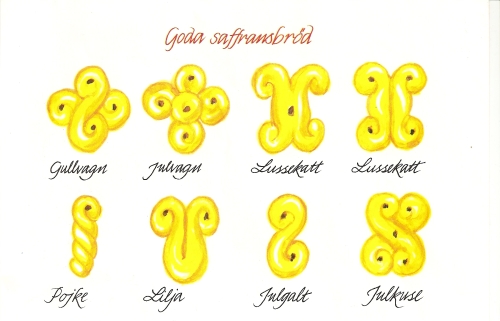 |
| Recipe here. |
Category:
holidays,
Saint's Days,
Scandinavia,
winter
4
comments

Such a bustle ensued that you might have thought a goose the rarest of all birds; a feathered phenomenon, to which a black swan was a matter of course -- and in truth it was something very like it in that house. Mrs Cratchit made the gravy (ready beforehand in a little saucepan) hissing hot; Master Peter mashed the potatoes with incredible vigour; Miss Belinda sweetened up the apple-sauce; Martha dusted the hot plates; Bob took Tiny Tim beside him in a tiny corner at the table; the two young Cratchits set chairs for everybody, not forgetting themselves, and mounting guard upon their posts, crammed spoons into their mouths, lest they should shriek for goose before their turn came to be helped. At last the dishes were set on, and grace was said. It was succeeded by a breathless pause, as Mrs Cratchit, looking slowly all along the carving-knife, prepared to plunge it in the breast; but when she did, and when the long expected gush of stuffing issued forth, one murmur of delight arose all round the board, and even Tiny Tim, excited by the two young Cratchits, beat on the table with the handle of his knife, and feebly cried Hurrah.In the past few days, I've learned a thing or two about goose. In Victorian England, thousands of geese were marched from the countryside into the big cities in the month before Christmas. They would be fattened one final time, then hung fresh in the butcher's windows just in time for the holidays. Turkey, our modern favorite, on the other hand, was something of a delicacy. Turkeys did not adjust well to the Old World, and were finicky, prone to illness. Their feet were more delicate as well, and they were often fitted with special shoes to try and make the march into cities. This means that the Cratchit's goose was most likely a very poor little creature, bought cheaply from a farmer and then fattened in their yard on what little they could spare, while the prize turkey Scrooge purchases for them was a massive feast, something only affordable by the elite and trend-conscious. A princely gift for the family of his previously disregarded clerk.
Now-days, though, the situation has reversed, and a buyer needs to be mentally prepared to spend more money for a 10 pound goose then you would a big turkey. It's worth it. Not only that, it's rich enough that everyone ends up having less. Still, as frugal as I am, that was my biggest moment of self-doubt in our Yule experiment--will it all be worth it when we're scrimping to have this as our Yule feast? It was, in spades. Part of that cost is because geese DO NOT survive being factory farmed the way turkeys do. They require much more care, and good conditions, so that means that higher cost means that you are 1) supporting a small farmer somewhere, and 2) buying a far more ethically-raised creature.
 | |
| Apologies for the poor quality of my phone. |
The first step I took was to pierce the skin all over. I used a very sharp knife, but something like a shishkabob might work really well too; the goal is control, getting through the skin, but not cutting into the flesh underneath. Like a tattoo artist, it's a painstaking process, but after the first 5 minutes or so, you start to get a feel for where has deep fat (like trying to poke a marshmallow), and where you're directly over the flesh or bone. Don't forget to lift the wings! Those are long wings, with a big fat deposit hanging out underneath--I can see forgetting down there leading to a huge chunk of very greasy meat.

Next, I used a dry rub. I looked at over a dozen sites trying to decide whether to brine or not(as I do with my yearly turkey), and the picture I started to see was that while you *could* brine, it made the goose much more greasy, and no crisp skin. On the other hand, if you were using a wild goose, brining seems imperative, as the meat is much drier and darker(also making the cooking time significantly shorter). There will be some weeping you need to dry off before you put on a rub.
I used the spices I would have used in a brine in my dry rub:

Goose Rub:
1/2 cup Kosher salt
1T cinnamon
2 t. clove
2 t. cardamom
2 t. white pepper
1 t. fresh ground black pepper
1/4 home-made candied orange peel (the dry kind I made last January, not the sticky kind), chopped fine or run through a food processor. Try to scoop up some of the citrus-flavored sugar that ends up in the bottom of your container.
Rub the bird, inside and out. You might want to wear a glove for that, because even though a goose is smaller then a turkey, it's long. Very long. By the time I got my handful of rub all the way up to the neck I wasn't sure whether I felt more like I was aiding a delivery or looking for Narnia.
 |
| Holy neck, Batman! |
Don't throw that grease away, either!!! That is schmaltz! I wouldn't go so far as to serve it on bread the way some Ashkenazi Jewish families do, but it is wonderfully flavorful. Let it cool, strain it, then refrigerate or freeze it (I poured it into a large mason jar). Use a little bit to fry up potatoes, or saute veggies...there's a ton of flavor, so you don't need much at all.
There is a trick to carving goose, you can find here.

Other recipes of the night:
Wild Rice Dressing
Note: I put prunes in this, and didn't like them at all. They made the rice very sticky and gummy....too rich. Everything else about it was good, but I omitted the prunes.
1 T. olive oil
1 onion, chopped
1 apple, peeled and chopped
Splash dry white wine or Fre
1 stalk celery, chopped
2 cups wild rice blend
2 t. salt
fresh ground pepper
2 t. summer savory
2 t dried parsley
1/2 cup apple cider vinegar
3 1/2 cups good chicken stock (preferably home made)
1/2 cup walnuts or pecans (optional)
Cook apple and onion in olive oil over medium-low heat until caramelized. Deglaze pan with white wine, add celery, stir and cook for a couple of minutes while wine soaks into the fruit and vegetables. Add rice and seasonings, and raise temperature, stirring well. When you start to smell a slight toasty smell from the rice, add vinegar and stock.
 Bring to a boil, then reduce heat, simmering gently for about 1 hour, then resting for 10-15 minutes. Keeps warm well moved to a casserole dish in the microwave. Toss toasted nuts in before serving. If used as stuffing, rather then just on the side, wait until the last half hour of cooking.
I also made Lussekatter, Sweet and Sour Saurkraut, Brussels sprouts (since my kids don't like saurkraut), and roasted carrots and turnips in the hot roasting pan while the goose was resting. A common recommendation to go with goose is a dry white wine, like Riesling, if you are so inclined(although Brussels sprouts seem to be notorious for not pairing with anything, so I'd avoid those).
Had home-made fruitcake for dessert.
`A Merry Christmas to us all, my dears. God bless us.'
Which all the family re-echoed.
`God bless us every one.' said Tiny Tim, the last of all.

Gordon Ramsey's take
A traditional Swedish Martinmas goose (PDF)
Category:
apples,
ciitrus,
dried fruit,
fruit,
history,
holidays,
poultry,
recipes,
the Victorians,
winter
1 comments
