Ok, folks, it's been crazy around here.
We finally have a new apartment, and will be moving in on Sunday...no more cooking on a hotel mini-range!
New posts coming soon, including a summer tea, book review for The American Girls Handybook, and pictures from Maker Faire!
 |
| Image via freedigitalphotos.net |
Up until recently, the time I did spend in coastal areas was with the Big Store mentality, i.e. go to Costco and buy a giant bag of flash-frozen pre-cut identical fillets that were farmed in Southeast Asia. Nothing wrong with buying frozen fish. Especially if you happen to be inland or don't cook often enough to go through a fish. However, there are some scary issues cropping up with farmed fish, especially the stuff from Asia, so choose wisely.
The past couple of years, though, I've been learning about how fish used to be done, when fish meant going to your local fishmonger. I can thank my husband for this: he spent two years in Japan, and got used to some insanely good fish. That meant that the first time we walked into the little Asian market in Japantown, San Francisco, I stood there and stared at the fish counter. No fish smell. None. Zero. It smelled like ocean water in there. Fish doesn't have to smell like fish?!
The rules:
1) Fish should not smell like fish!
If your fish smells like fish, it's old. Nothing you do will improve it. Whole fish should have bright eyes (not sunken or dull), shiny scales without patchy or discolored places, bright red gills, and smell like the ocean. Fillets should also smell fresh, with no cloudy liquid. Also, smaller and/or lower on the food chain contains less mercury: skipjack tuna versus Albacore, for example.
2) It's almost always easier to buy sustainable seafood locally. Organic doesn't mean much in terms of seafood (since wild-caught is healthier and more sustainable), but Marine Stewardship Council certified does. You can also check out the great Seafood Watch program from the Monterey Bay Aquarium.
3) Find a fishmonger or local seafood market. A real one, not a guy at the meat counter at the grocery store. Obviously, this is harder to do these days, and it can take some hunting. Go in (smell the air!), strike up a conversation. Ask what's fresh that morning, how it was caught, what's in season. Like most small farmers, bakers, beekeepers and anyone who loves their craft enough to stay small, a good fishmonger will be chatty and enthusiastic if you come in with a friendly and curious attitude.
Looking for fresh fish in the Bay Area? Here are some options I'm going to be trying soon (if I'm missing a good one, leave me a comment!).
San Francisco Fish Company
Right off the docks at pillar point in Half Moon Bay. I hear that the Harbormaster suggests calling at around 9am the day you're going to be there to see what's available. Fishfone 650-726-8724.
Mission Market Fish and Poultry
Cook's Seafood in Menlo Park
Race Street Fish and Poultry Market, San Jose
Many Bay Area farmer's markets also have fish stands...all rules apply! Good fishing!
Category:
fish,
Food Safety
0
comments


This morning on The Flog, Felicia Day did a Steampunk photo shoot. Between her and Clockwork Couture's beautiful things (so much fabric envy right now), it was a must share.
Who is Felicia Day, you ask?
Codex on The Guild.
Previously, the love interest Penny on Joss Whedon's creation, Dr. Horrible's Sing-Along Blog.
Obviously, geeky goodness...you will regret it if you don't take a look!
Who is Felicia Day, you ask?
Codex on The Guild.
Previously, the love interest Penny on Joss Whedon's creation, Dr. Horrible's Sing-Along Blog.
Obviously, geeky goodness...you will regret it if you don't take a look!
Category:
aesthetics,
Steampunk
1 comments
 |
| From the blog Logismoi. Full article there discusses Walpurgisnacht and Dracula mythos. |
Happy May Day! I've found something new this year...I've often heard the term Walpurgisnacht used to describe the night before May Day...it's traditionally a time in Northern and Central Europe (most often it would seem in Germany, Norway, Estonia and Latvia) when big bonfires are held, and parties thrown. Most of these traditions date back to the Europe's witch hunt era, and the feel is often similar to Halloween--a date six months later. In Bavaria it's know as Freinacht, and pranks are played as well.
Saint Walburga traveled from England to Germany to proselyte sometime around the year 748 A.D, and became a very powerful and influential Abbess. She was known for healing, and even after her death was said to have a healing "oil" rise from her grave(the reason for the flask she is often shown carrying).
 |
| Oldest known image of Walpurga, from the Hitda Codex. |
In addition to the flask, she is sometimes shown with a book to represent her writings, as well as heads of grain. The story often goes that she fed a starving child using only three heads of grain, however this tale seems to be a later addition. There is some fascinating evidence that the Saint became a stand-in for an older Germanic grain goddess, taking on the role of "protectress of crops".
This is the point where it gets complicated, though, since the older goddess is often only referred to as Walpurga. She is often linked to the Wild Hunt in this form;
"Nine nights before the first of May is Walburga in flight, unceasingly chased by wild ghosts and seeking a hiding place from village to village. People leave their windows open so she can be safe behind the cross-shaped windowpane struts from her roaring enemies. For this, she lays a little gold piece on the windowsill, and flees further. A farmer who saw her on her flight through the woods described her as a white lady with long flowing hair, a crown upon her head; her shoes were fiery gold, and in her hands she carried a three-cornered mirror that showed all the future, and a spindle, as does Berchta. A troop of white riders exerted themselves to capture her. So also another farmer saw her, whom she begged to hide her in a shock of grain. No sooner was she hidden than the riders rushed by overhead. The next morning the farmer found grains of gold instead of rye in his grain stook. Therefore, the saint is portrayed with a bundle of grain." (Rochholz,Drei Gaugtinen (Three Local Goddesses), 1870, p. 26-27)
For more such quotes, linked to a pagan perspective, this article on Frigga's Web is excellent. Many Asatru and similar groups now honor Walpurga because of this mixed history. For more about May Day celebrations, and traditions such as maypoles, the may queen, and the U.K. tradition of Morris Dancers, go here.
Category:
holidays,
Saint's Days,
summer
0
comments

Alright, not a food related person today, but one of my personal heroes of the Gilded Age. This is an amazingly capable, strong woman, who deserves to be known, especially by those who have a thirst for adventure.
Born Elizabeth Cochrane on May 5th, 1867, Bly's father died when she was six years old, leaving her mother to care for a total of 15 children. She moved to Pittsburgh at the age of 16 to find work, and dreamed of becoming a writer in an era when women who worked outside the home or the very narrow fields of nursing or teaching were often ridiculed. Opportunity came by chance when at 18 she wrote a passionate anonymous response to the columnist Erasmus Wilson, who wrote for the Pittsburgh Dispatch as "Quiet Observer". The paper was impressed, and placed an ad, requesting that she come forward, and giving her a nom de plume based on a popular Steven Foster song.
Such a domestic sentiment to try and temper her outspoken nature followed the early portion of Bly's career. As she attempted to draw on her own experience, writing articles about conditions in tenements, and the difficulties faced by factory worker and maids, she pioneered many features of modern investigative journalism, going undercover and taking jobs herself, rather then simply relying on speaking to others. Despite this groundbreaking approach, her work was often left in the middle of the society and garden section, the only place a select few women journalists had a voice.
In September of 1887, she managed to join the staff of Joseph Pulitzer's The New York World, the beginning of her most amazing adventures. She raced around the world in 72 days, beating all similar records set by men, exposed shady lobbyists, and covered the plight of unwed mothers. She contrived her own arrest on larceny charges and reported her experiences being strip searched and spending the night in a coed jail, and interviewed controversial figures such as Susan B. Anthony and famous anarchist Emma Goldman.

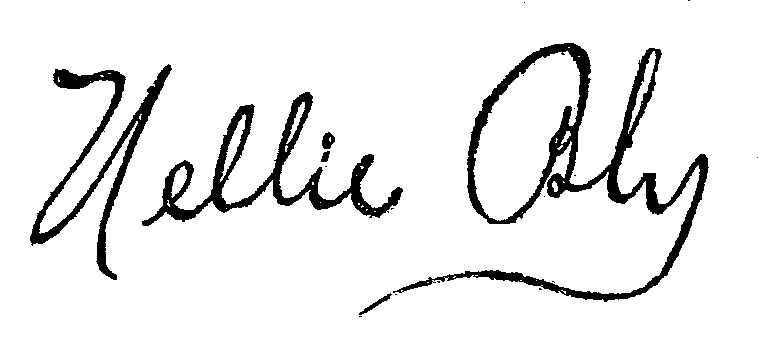 Authors like Nellie Bly remind us where we have been. That only three generations ago, four at most, women could be imprisoned as mad simply on the word of their male relations. We could not vote or run for office, and even if widows like my great-grandmother were prevented by social stigma from getting a better-paying job then the brutal life of a laundress. In a divorce, the male spouse would keep whatever the woman had brought into the marriage, as well as the children, and have complete say over his wife's assets while married. Women like Bly, Susan B. Anthony, and yes, even controversial spitfires like Emma Goldman are WHY we now have the rights we do. Many women in the world still do not, and it's important to remember that, and not go backwards. We stand on the shoulders of our great-grandmothers. I only hope I can live up to standing on the shoulders of the likes of Nellie Bly.
Category:
American history,
biographies,
the Edwardians
1 comments
 |
| Via. Captain Hops |
It's been a while since I did a really Steampunk post, and I've been thinking a lot about all the different ways that someone can "Steam up" a menu, something we've talked about before. Normally, I take a soft eclectic approach, and tend to think in terms of, say, and airship galley, going from port to port across the globe. Someone like Aaron over at Steampunk Cookery takes a much more classical approach: modern updates on popular Victorian and Gilded Age food. Another potential way is by influencing aesthetics, such as reducing plastics or investing in interesting gadgets.
Today, I want to go somewhere a little different with the concept; using normal tools most people already have, but in food preparation. I see this as the engine room approach, like a bunch of guys together in the belly of whatever monstrous contraption they're payed to run. If done right, this could also be a great show for dinner guests, though, especially where fire is involved.
Before I get into ideas, though, I'm going to stress two things:
1) Be Careful! Even in experienced hands, many power tools can lead to accidents. Wear appropriate gear, and if you're young, or haven't dealt with tools much, conscript the help of someone who has more experience.
2) Clean Your Kit! Using dirty tools to make something you're going to eat is a bad plan! New tools, or ones that have been scrupulously cleaned, please!
Now, on to ideas!
| Rosemary Stuffed Lamb Bone from Ideas in Food |
There is a lot of stuff out there for drills....wow. The most obvious one is stuffing things, whether they be apples or zucchini. Easy enough...how about mixing bread dough?
 |
| More insane blowtorchery at Essential Ingredient |
You can also provide some last-minute color to a roast or gratin, quickly heat the bottom of a metal bowl to keep a frosting or meringue from breaking, or warm a chilled springform pan for quick release. (I got this trick from Spago pastry chef Sherry Yard, who does this for cheesecakes.)
What about using the heat of an engine to cook? In one episode of Bizarre Foods with Andrew Zimmerman, the concept is referred to as "muffler meat":
As Zimmerman notes, these gentlemen are using a specially built box to safely cook their food. Other sources have instructions, though, for basic cooking(as always, be careful), and under the slightly more dignified title of Engine Cooking, this concept even has it's own Wiki page, with even more useful links.
Some approaches I found, on the other hand, were purely decorative, or seemed to be more for the sake of doing it then actually being more useful or convenient. Spindle-turned root vegetables or using a mini orbital sander to grate nutmeg fit in this category for me. At that point, the earthy quality that makes this sort of thing appealing to me is gone.
On that note, I leave you Carrot Cake--with power tools!
Category:
aesthetics,
cookware,
Steampunk
0
comments
Hey all,
Things are going really well with the Blog. GG's Kitchen isn't super-popular, but it's slowly but surely making onto the map...I was very surprised to see over a thousand hits last month! I know, small potatoes for many blogs, but certainly the most attention a project of mine has ever received. I am touched that people care about the odd blend of Victorian foodies in my little corner of the internet.
If you haven't noticed, we are now on Facebook as well! I'm putting up a lot of pictures, odds and ends, and things I find fun, but don't want to do a full blog post on, so check it out, tell your friends, etc....
In other news, I am still in a bit of a housing limbo, which is why there are still tea menus, Saint's Days, reviews and the like, but no new pictures of my own cooking projects. Otherwise, our family move to the California Bay Area has gone wonderfully...my spouse has had some great interviews so far, and I am now working as a server for a very well-run restaurant. The support and help of our friends and family has been immeasurable, and I look forward to cooking, preserving, and baking again shortly!
Things are going really well with the Blog. GG's Kitchen isn't super-popular, but it's slowly but surely making onto the map...I was very surprised to see over a thousand hits last month! I know, small potatoes for many blogs, but certainly the most attention a project of mine has ever received. I am touched that people care about the odd blend of Victorian foodies in my little corner of the internet.
If you haven't noticed, we are now on Facebook as well! I'm putting up a lot of pictures, odds and ends, and things I find fun, but don't want to do a full blog post on, so check it out, tell your friends, etc....
In other news, I am still in a bit of a housing limbo, which is why there are still tea menus, Saint's Days, reviews and the like, but no new pictures of my own cooking projects. Otherwise, our family move to the California Bay Area has gone wonderfully...my spouse has had some great interviews so far, and I am now working as a server for a very well-run restaurant. The support and help of our friends and family has been immeasurable, and I look forward to cooking, preserving, and baking again shortly!
Category:
ramblings about myself
0
comments
