Cherry Blossom Tea Menu


"In these spring days,
when tranquil light encompasses
the four directions,
why do the blossoms scatter
with such uneasy hearts?
Ki no Tomonori (c. 850 – c. 904)


The next two weekends are the 45th annual Cherry Blossom Festival in San Francisco.  It is the second-largest cherry blossom festival in America (Washington D.C. is celebrating it's 100th year of celebrations this year, the original trees being a 1912 gift from Viscountess Chinda, wife of the Japanese Ambassador, and later a breathtaking 3000 trees from Mayor Yukio Ozaki of Tokyo), and the only one to take place in one of the three remaining Japantowns in America. 

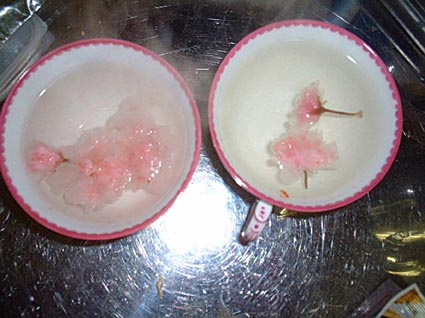
Sakura-yu
In Japan, the practice of going out and having picnics to view the blooming cherry trees is called Hanami, based on an older practice from China involving plum, rather then cherry trees. Old in this case, is slightly arbitrary, though, since Hanami has been going on since the Heian period (794-1185)!

There are often many traditional treats involved, using the pale pink of the blossoms, or even the flowers themselves for flavoring;  Sakura No Siozuke (the salted blossoms),

If you don't live in an area with a good Japanese grocery, here's a menu that would be great for a simple picnic in the lovely spring weather. It uses ingredients that should be easy to find, and is a great introduction to Japanese food.

Hanami Dango (a sweet treat made with glutinous rice)

American Hanami Menu:

Sekihan Rice (rice with adzuki beans and black sesame seeds)

Simple Temakizushi(hand-rolled sushi--the way it's usually eaten at home or picnics, rather then when purchased pre-made); take sushi rice, fillings such as fish, avocado, and crab(or even the salted cherry blossoms above), and cut nori seaweed into squares. Each person  makes their own, using the nori as a base, and then wrapping it around the rice and fillings.  For more information and ideas, try here, here and here! As simple or complicated as you want to make it.

Yakitori (Grilled chicken--very good cold!)

This pretty Hanami Salad would be a great addition as well.


Tea Suggestions:

Matcha, good quality whole-leaf green tea, or cherry blossom tea like Sencha Sakura or  Harney & Sons.

Dessert? Great Sakura Mochi recipe here.

Is the Premiere Issue of Vintage Style Worth It?


Just before moving, I noticed this one on the magazine stand and got a copy.  While normally $9.95 would be out of my price range for a magazine, I liked the curtains made out of old cloth napkins (aren't they cute?!), and wanted some reading material for the road.

Published by the same people who do Country Almanac(Country Living, Country Home, Romantic Homes, etc.), it is professionally done, with beautiful glowing photographs and a nice range of styles within the unifying theme of vintage decor.  I particularly enjoyed the spread on different ways to use old Mason jars (a switch I've been trying to make myself), and the gorgeous distressed furniture in some of the homes.  There is also a useful article on how to go about shopping at flea markets, particularly for large furniture pieces. 

However...on the whole, I personally think they have missed the mark on their potential demographic.  Sure, home decor magazines are normally geared towards older housewives, who can afford to dabble in redecorating and design. This particular breed of Retro, ranging from Victorian to mid-Century and mixing in modern and even industrial or re-purposed pieces is huge right now with twenty and thirty-somethings.  Foodies(although I appreciate the lack of food in a design magazine).  Neo-Victorian, Steam- or Dieselpunk, and yes, even Hipsters.  Some of the advertising hits the mark, like creative vinyl transfer wall art.  Others, not so much(a tacky John Deere Cuckoo Clock for $200? Not when you can find the same sort of junk to put on your hipster wall ironically from a thrift store somewhere). 

I'll be looking for the next issue, if nothing else to see if they manage to realize the potential for a younger demographic.  I'm not sure, though, if I'm willing to pay full price for it, so we'll see.

For more examples from inside the magazine, check out this post over at Dutch Door Cottage, and this one from High Prairie Farm Girl.

Chocolate Done Right

From Co-Operative Food UK
Where does your chocolate come from?

For my grandmother, buying chocolate was Ritual.  While she no longer wore a best hat or wore gloves, it was easy to imagine her slipping them on as she prepared for an outing to buy chocolate.

Les Marais Chocolates, Santa Monica, CA
It was part of hospitality, and I felt so very grown up when I was lucky enough to be at her house when she was going out to perform this feat.  We drove in the car to the original Mrs. Cavanaugh's, since my grandmother had known her personally back in the day.  Inside, I would smell the chilled air and laugh about the picture on the wall of a chocolate moose while we waited.  Then the choosing began...who was coming?  What were their dislikes?  Allergies?  My grandmother hovered over the glass case like a nervous bird, picking each chocolate individually.  Woe befall me then if I tried to interject!  These were for the adults, to be arranged carefully on a plate or in a dish, even if no one touched them.

Such attitudes have mostly fallen by the wayside, which makes sense when most chocolates are mass-produced, and sold in preselected mixes at the grocery store.  This is not the way is should be, though, and American chocolate in particular has suffered for it.  Hershey's is waxy.   Most candy-bars more candy coating then cocoa.  Chocolate risks become a condiment, with no more thought given then to a bottle of Heinz Ketchup.

In the meantime, our disconnection with where our chocolate comes from risks endangering chocolate all together.  Problems like climate change and deforestation mean that the cost of plants like cacao, peanuts, and coffee grown in Africa are expected to soar in the near future, due to a combination of environmental factors and human rights issues. 
Chocolate-covered marshmallow from Theonista

We, as the consumers, rarely can predict the rout that our chocolate (or other exotics like cane sugar or vanilla) took to reach us, but we can do our best on our end to support those who bring chocolate to our tables this Easter season.

Buy from local shops, like  my grandmother did, keeping your money with small local businesses. If you don't know one in your area, try search functions like Yelp to find one.  My favorite while living in Idaho was Florence's, a small mom and pop place.  Don't be afraid to ask questions, either.  The modern American business climate is often hard on small stores, who have trouble competing with large monopolies like WalMart and Costco even on specialty items.  The small local business where you live might not know where it's cocoa comes from either...unless you ask questions.  Chocolate often passes through many hands before it reaches you.

Schurra's Fine Confections
If you can't find a local shop, here is a list of how the large brands stack up in terms of ethical practices, particularly child labor(as well as a list here of smaller, more ethical brands).  While looking for products that claim to be Fair Trade(meaning that the farmers and workers who harvest the crops are given a livable wage), can help, some large brands have recently fallen under criticism for using it without following the requirements.

Today, my family will be checking out a South Bay staple for the first time: Schurra's Fine Confections.  While I'm not putting on a hat and gloves, I will be looking for a small local business that knows it's chocolate--from beginning to end--to buy my candy this Easter.

Update:  I ended up making a holiday out of it and checking out three chocolate shops in South Bay today.  Schurra's, which I listed above, was first.  Classy shop.  Not the most creamy chocolate, but the egg we tried was hand-made and much better then a similar peanut butter-filled item from the grocery store. 

Next, we went down to Los Gatos and checked out the Powell's Sweet Shop(local chain).  This is very much a candy store...every candy you can think of, with a little chocolate counter to round things out.  Not what I was looking for today, but my kids loved it! At the very least, between here and the imports at a store like World Market, we should have Christmas amply covered.  Also got myself a pack of the classic Choward's Violet Mints from the 30's. 

Last was Chocolate Dream Box.  Very, very good.  I would go to Schurra's unless I was in the area, but theirs tasted like the best quality, highest chocolate content, and the individual chocolates in the case were dazzling. 

Great Grandmother's Easter

More beautiful vintage cards can be seen at the Greencastle Museum website. 


Art by Thalia Took
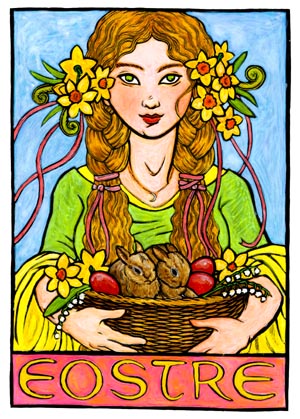
Easter time is a unique blend of  Catholic and Pre-Christian traditions all over Europe.  The name of the holiday itself comes from a Germanic goddess, and variations on the name range from Eostre to Ostara. Linguists theorize a Proto-Indo-European word awes, meaning "to shine", which would explain similarities to Greek and Roman dawn goddesses(Eos and Aurora) as well as the minor Indian goddess Ushas.  Whatever the case, at least in Northern Europe, common themes are flowers, hares (the predecessor of the Easter Bunny), and eggs. This linguistic link does not carry over into cultures that speak Latin-based languages, however, where Easter is called La Pasquette, Paques, or Pascua. 

The date of Easter changes each year(unlike stationary holidays, like Christmas) because it falls on the Sunday after the first full moon following the Spring Equinox.  Why this reliance on the lunar calendar?  Because the Council of Nicaea reasoned that Passover, which falls on that new moon, would have come directly before the death of Christ. 

 So what did our great grandmothers do for Easter?  It depends...while many traditions translate easily to similar American customs, others are very unique. 

There are eggs a-plenty:

 
Spectacular Swiss Eggs from You Craft Me Up
Romanian Eggs
From Poland

As well as bread and cakes:
Greek Easter Bread, recipe here. 
Swiss Easter Cake
Hot Cross Buns, a favorite at our house.


In Sweden, little children also dress up as Easter Witches, complete with painted red cheeks and freckles, and go door-to-door for treats, based on a tradition that all the local witches fly over the water to a mountain in Northern Germany the Thursday before Easter for a meeting with the devil (another one of those "huh" moments...some suggest the tradition dates to a rather ugly witch hunt in the 1600's). 

A lovely Victorian Easter Witch
Interested in other strange Easter traditions?  Here's a collection! 

Whether Christian, Pagan, or purely secular, this time of spring is a wonderful time to celebrate new life, and the return of light over darkness.  Happy Easter!

Book Review: 1001 Ways to Please a Husband


I stumbled on this one in a local thrift shop in Idaho, bearing the stamp of the "Cuyahoga County Public Library", and the copyright date 1958.

Apparently, it was a common practice in the first half of the 20th Century to write cookbooks geared specifically towards new brides. Because of this, the book contains basic, useful advice about making good use of the freezer, cooking with cheaper cuts of meat, budgeting and finance advice, and menu planning. Much of this would still be useful today, and I found the freezer section helpful in my ongoing efforts to reduce plastic in my kitchen.

It turns out that Myra Waldo, the author, was well-known at the time for her international cookbooks(even ones on South American and African cuisine), in addition to a successful career as the food consultant for Pan American Airlines.  While I can't find a birth-date for her, the date on the cookbook means that she was definitely at the height of her career, explaining the mix of recipes ranging from new and upcoming(fondue) to classic French, to Victorian foods beginning to disappear(potted meat), in addition to expected 50's fare of biscuit crusts, canned soup casseroles, and various meat-based loaves. All-in-all still healthier then the food served in many modern American homes.

What is even more interesting to me, though, is what her commentary tells the reader about 50's perceptions of a good housewife.  Little fictional diary entries through the book tell the story of the first year of marriage for Peter and Jane, and follow Jane's first efforts at such challenges as cooking on a particularly tight budget and acting as a hostess for girl's luncheons, cocktail parties, and dinners.

This is easily the most fascinating aspect of the book to me. Jane is shallow And officious, convinced of her own irrationality. She gloats when her husband is inept in the kitchen, and seems determined to prove herself better at homemaking then her friends, even occasionally at their expense. Particularly cringe-inducing is her insistence on feeding "exotic" friends dishes from their native lands, as a vehicle to introduce such exotic ideas as pizza and fillet of sole, bonne femme. Thus, the introduction to a Sukiyaki recipe is all about Peach Blossom, the Japanese War Bride who (gasp) speaks perfect English and rushes to obey her spouse's every whim.

A moment of culture shock, indeed. It's easy to forget just how much more acceptance there is now in terms of different ethnicities, interracial marriage, and even something as basic to the "plot" as a woman's ability to run her own life. An excellent reminder that, while the past is fun, I'm fairly sure I wouldn't want to live there...especially when there is still so much room for racism in modern American culture.

Jane, commenting on the meal "her Japanese War Bride" helps prepare;
It was simply delicious, and I don't know where I ever got the idea that Japanese people eat nothing but seaweed soup and raw fish...I had made a chocolate roll for dessert, not knowing whether or not anyone would be able to eat the sukiyaki. But they ate the sukiyaki down to the last spoonful and then proceeded to devour the chocolate roll. P.B. thought the chocolate roll was terrific, and asked me for the recipe. The United Nations? I suppose P.B. and I did our little bit to further international relations in our own quiet way.

A simple but international menu:
Sukiyaki
Beer
Chocolate Roll

My Japanese War Bride Sukiyaki from 1001 Ways to Please a Husband by Myra Waldo, 1958
(for six to eight)

3 onions
1 cup celery
1 cup canned bamboo shoots
1/2 pound mushrooms, or 2 cans, sliced
4 scallions (green onions)
2 pounds sirloin steak
4 tablespoons salad oil
1/2 cup stock or 1/2 boullion cube dissolved in 1/2 cup boiling water
3/4 cup soy sauce
1/4 cup sugar
1 tablespoon sherry
1 pound vermicelli or thin noodles, boiled and drained

Sukiyaki is fun to prepare--you can cook it almost as the Japanese do-- at the table in a chafing dish or electric skillet, or on the range in a skillet. Prepare the vegetables early in the day or whenever you have time and wrap them individually in aluminum foil, waxed paper, or Saran wrap. When you're ready to cook it, the entire operation will just take a few minutes.

Slice the onions very thin. Cut the celery in 1-inch lengths. Slice the bamboo shoots, mushrooms, and scallions.

Cut the steak into strips 2 inches long by 1/2 inch wide. Mix the stock, soy sauce, sugar, and sherry in a bowl.

Don't begin to cook the dish more then 15 minutes before you are ready to serve it.

Heat the oil in the utensil of your choice. Place the steak in it, and brown on all sides. Push the meat to one side of the pan and pour half the soy sauce mixture over it. Place the onions and celery in the pan and cook over medium heat for three minutes. Push to one side. Add the bamboo shoots, mushrooms, and remaining soy sauce mixture to the pan and cook 3 minutes, add the scallions and cook 1 minute.

Serve directly from the skillet, or heap the vermicelli on one side of a heated platter, and arrange the sukiyaki in the other.

Chocolate Roll

2 squares(ounces) unsweetened chocolate
2 tablespoons brewed coffee
4 egg yolks
3/4 cups sugar
6 tablespoons sifted cake flour
1/2 teaspoon baking powder
1/4 teaspoon salt
1 teaspoon vanilla
4 egg whites
Cocoa

Turn on the oven and set at 400 (hot).

Grease a jelly-roll pan (11 x 16 inches) and line with waxed paper. (GGK note: it would be much wiser to do this with parchment paper, as waxed paper is not designed to get hot.)

Combine chocolate and coffee in a cup; place over hot water and let melt.

Beat the egg yolks until light; add the sugar to the yolks, beating well. Sift the combined flour, baking powder, and salt over it, mixing until blended. Stir in the vanilla and chocolate.

Beat the egg whites until stiff but not dry. Fold into the previous mixture thoroughly. Spread evenly in the pan.

Bake 13 minutes or until a cake tester comes out clean. Loosen the bottom by running a spatula under the cake.

Sprinkle a towel with cocoa and turn the cake out onto it. Carefully peel the paper from the cake. Roll up gently in the towel and let cool for one hour. Don't worry if the cake cracks. Unroll and fill with whipped cream, ice cream, or soft custard. Re-roll and serve.

Shampoo, or Lack Thereof

From the Hair Archives
Normally, I stay roughly on Kitchen topics at GGK, however, my friend Thalassa over at Musings of a Kitchen Witch has been talking lately about other ways then shampoo to keep hair clean(you can find her posts here and here).  Since I no longer use traditional shampoo either, she asked me to talk about what I do as well.

Now, shampoo as we know it, didn't exist until the 30's.  While some shampoos began to hit the market in the early 1900's, they caused alkaline reactions, leaving a gray film on hair.  Dr. John Breck invented the first PH-balanced shampoo, and the companies ad campaign, featuring Breck Girls, lasted well  into the late 70's. 
Olga Armstrong, the first Breck Girl
This led to a cultural expectation of frequent hair washing., and the idea (at least in America), that oil in hair means that it's dirty.  I grew up in a family in which everyone washed their hair every morning, and my grandmother told horror stories about her years as a school teacher, and trying to get shampoo for one of her students who was teased for her stringy hair, only to have the child's mother say it "looked too fly-away" and put grease on it!  Even so, my grandmother would get her hair done at the hairdressers once a week, and usually only washed it mid-way if she had to, as it spoiled her look.

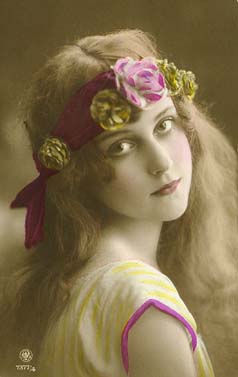
Cleo De Merode
So what did our ancestors do before the shampoo revolution?  According to this Victorian care guide, the solution was similar to many today who find that, unless their hair gets some foreign dirt in it, it needs no soap at all.  The guide stresses the importance of using a boar's bristle brush, and keeping it immaculately clean (even going so far as to suggest cleaning it with a diluted ammonia solution periodically).  It also suggests using a Castile soap (which has olive oil as a base, rather then the very harsh lye soaps which were the period alternative--no wonder people didn't use them on their heads!). The basic outline of their routine is to wash hair once per week.  Use Castile soap if one's hair is oily, but if it's dry, an egg yolk is a good alternative. and is a common cleaner for modern no-shampoo folks.  Hair was supposed to be brushed every night, the old "100 strokes" idea, which with a boar's brush and gently done, pulls oil down the length of the hair, keeping it from getting oily up at the roots, and drying at the base.  It's worth noticing, too, that it's suggested to rub the hair with flannel after, I'm assuming to soak up any additional oil the hair doesn't need.

If you want a great example of someone trying this method out, The Gibson Girl's Guide to Glamor has a very interesting post on the matter. 

So what do I do?  As an adult, I found that my hair did much better only being washed every second or third day (often depending on factors like how dry the weather is, where I am in my muenstral cycle, and stress).  While hair experts often disagree about how often is too often, many say that we wash our hair too often now, stripping it of it's natural oils at a rate that encourages the body to overproduce oil to catch up.

Via. Rapunzel's Delight 
A few years ago, I tried using no shampoo at all, and found it doesn't work well for me, personally.  My hair is baby fine, thin, and prone to being oily(especially at that time of month), and so all it did was slick to my head.  Someone with dry hair would have completely different results, though, and my friends who have tried this sort of experiment with "frizzy" hair find they often suddenly have curls.


More recently, I became interested in Castile soap and switched to Dr. Bronner's Magic Soap, available at health food stores, and now at Target.  The label is truly amusing...it contains everything from recipe ideas to scripture references, and reads like a 19th Century cure-all peddler's schtick.  However, I have to say, the stuff works.  I have switched to diluted forms of it for hand soap and cleaning, too.  Direct from the bottle it is very strong, and will leave your hair stripped and tangled...I strongly discourage using it that way!

My Shampoo Recipe

3T-4T Dr. Bronner's Soap (whatever scent you prefer...eucalyptus can help with dandruff, though)
A few drops of Essential Oils
1T Extra Virgin Olive Oil

Add to bottom of a large empty shampoo bottle.  Fill almost to top with filtered water.  Shake every time before use...this will leave a lot of foam on top that will make it easy to lather.

I use a rinse after that is Rosemary tea, and about a quarter cup of apple cider vinegar. Since the Castile soap is gentle, but not PH balanced, it makes up for that.  The Rosemary is because I have dark hair, and am prone to a bit of an itchy scalp in winter.  For other suggestions, go to my second link from Musings of a Kitchen Witch above.

Even though my hair is currently very short, I also brush it regularly.  I find that it's more important to stimulate my scalp then anything else...and my hair is much healthier with more body.  Like the Victorians, get a good brush and clean it often!  Also, if you try this, expect to need less product...a lot of our modern hair products are designed to make up for removing our body's natural oils.

The Amazing Seven Sutherland Sisters!
Did you notice how much olive oil I put in?  That has reduced how oily my hair is, ironically enough...it also helps to calm my scalp down with dry winter weather.  My husband's hair is not as oily as mine, though, and responds better with just a few drops of olive oil (his hair has become much more manageable, as well).  Another interesting side effect is that I no longer have little eczema patches on my back and arms, something I've battled for years!

What about those days when I don't have time to wash, or I'm almost to a shampoo and my hair is looking nasty?

Corn Starch Dry Shampoo

1 cup Corn Starch
Essential oils to scent the hair, or dry herbs (will scent it much more slowly...I like mint)


Mix together and store in a small container in the bathroom.  To use, take about a tablespoon of the cornstarch, and rub it all over your scalp.  Don't worry about ends so much...just where it looks greasy.  Then brush, brush, brush.  It takes about 5 min to not look like a ghost.  You will be surprised at how full your hair feels (this is also a great thing to do before trying some of those old hairstyles).

So there you go!  This is what works for me, personally.  If you have something you do and love, please share it in the comments!
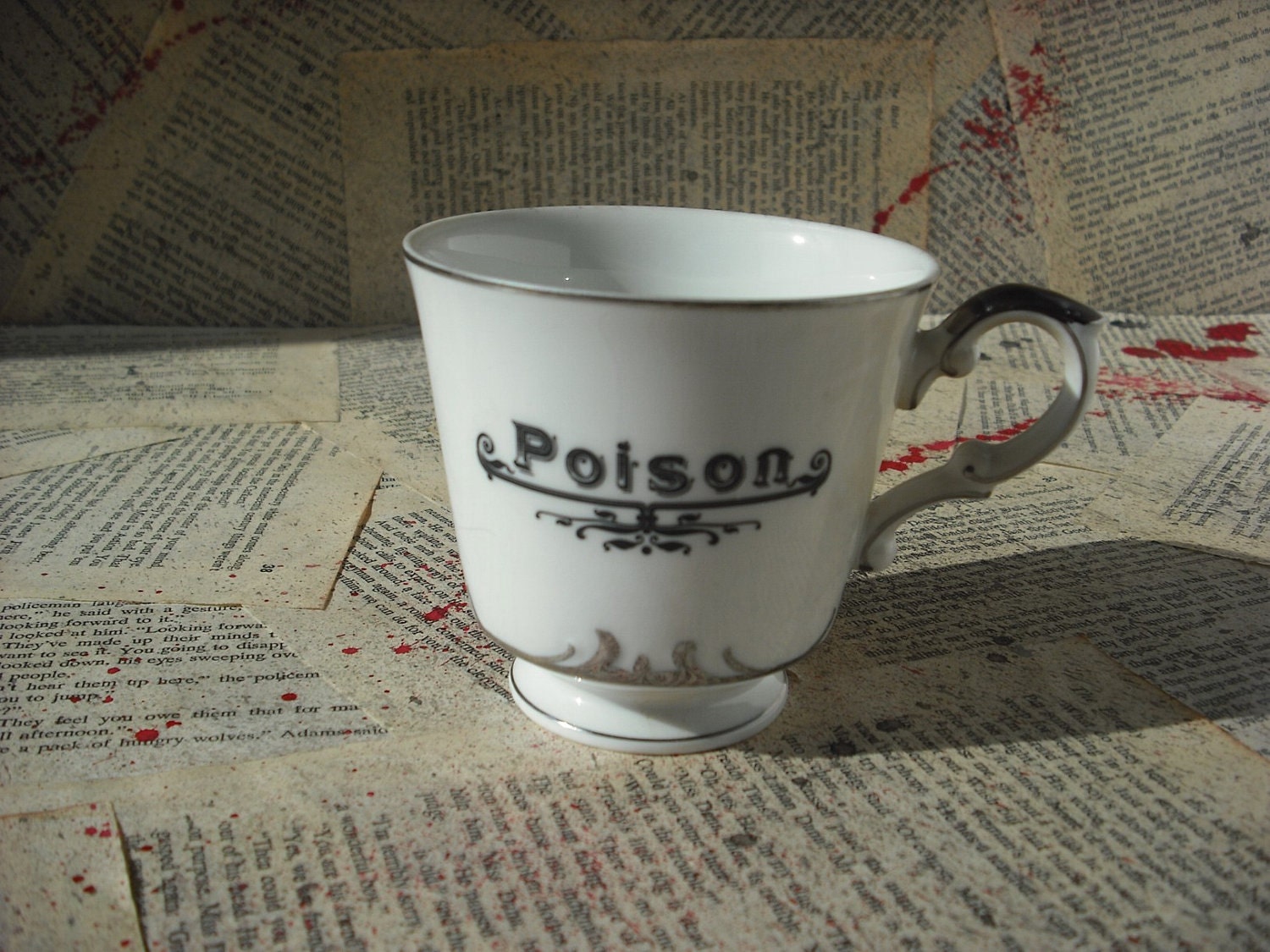
Very Gothic Valentine Tea

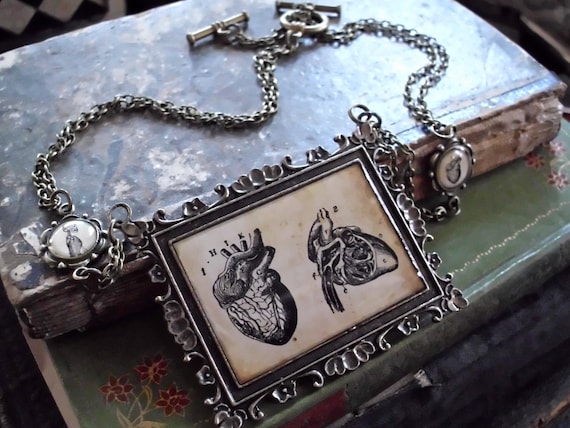
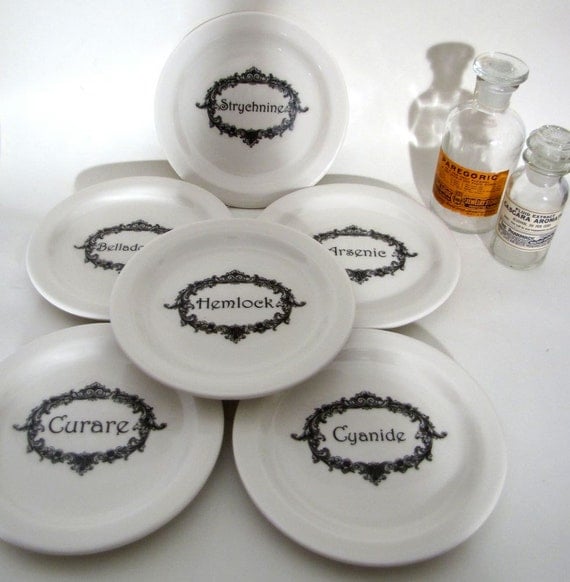
Etsy seller 1313MockingbirdLane
Death, The Sandman by Neil Gaiman

One would expect that, as big as I am on Victorian things normally, that I'd be really big on Valentine's Day, right?

Um...no.  Not so much.  It's ok, in it's way, but it often ends up being a bit over the top for me, personally.  There is so much about modern Valentine's practices that make it feel like obligation to me; my spouse still loves me whether he purchases me overpriced roses and chocolates on a certain day or not (and gets even more points when he does something unexpected, or buys me a potted herb or fern).  So this month, I bring you the anti-valentine tea menu...hopefully an antidote to your otherwise saccharine month. 

Menu
(Taking advantage of the spring flavors already trickling in from California)


Mini Asparagus Tarts with Lemon and Creme Fraiche

Radish-Butter Sandwiches (recipe below)

Open Faced Sandwiches with Cream Cheese and a Jam Heart (use dark jam like blackberry or fig)

Slices of Good Chocolate Pound Cake, with fresh strawberries.


Suggested Teas: Earl Gray, St. Dalfour Organic Black Cherry Tea, A good Spiced Chai.

Necklace by Etsy seller TheLysineContingency
I would strongly suggest penning invitations to this sort of engagement by hand, on antiqued paper. Background music could be classical, however for a more "lively" feeling Depeche Mode, Bauhaus, etc. would certainly be appropriate, as would scents by Dark Candles. 
Project from the blog Ever Kelly

Open Faced Radish Sandwiches

Good Sourdough Bread
Unsalted Butter (A great time to try the very nice Irish stuff kept with the fancy cheese at some supermarkets...whatever the case, as fresh as you can get)
Finely ground Sea Salt
Fresh Ground Pepper

Leave butter at room temperature for around 15 minutes--just enough to soften, but still spread thickly.  Slice bread, and cut into shapes or anything fancy you'd like to do.  Cut tops and ends off radishes, then slice thinly.  You can even use a vegetable peeler.  Spread bread with butter, then layer radishes, sprinkle with salt and pepper.

Very simple, but good, meaning that the quality of the ingredients you use is everything.  

By Etsy maker AustinModern